

Swift error is hard to swallow, as ‘Bird of the Borough’ has an identity crisis
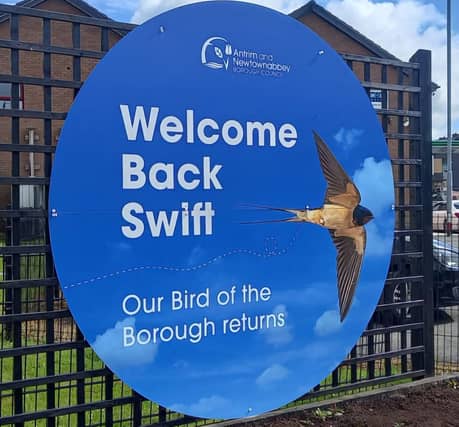

KEEN-EYED bird watchers have urged the Council to go back to the drawing board after the ‘Bird of the Borough’ was misidentified in corporate branding.
A sign welcoming swifts back from their incredible 6,000-mile migration from Africa, has described the breed in the singular - and also used a Swallow as an illustration.
Swifts were designated as the official ‘Bird of the Borough’ in 2015.
Antrim and Newtownabbey Borough Council was the first in Northern Ireland provide all planning applicants with a new ‘Positive Planning Note’, a dedicated guidance booklet focused on safeguarding the Common Swift.
The Council collaborated with the Royal Society for the Protection of Birds (RSPB), the Northern Ireland Swift Group, and the Department for Agriculture, Environment and Rural Affairs (DAERA’s), Natural Environment Division.
A Swift Champion is also elected by the council.
But local naturalist Mark Smyth says that feathers have been ruffled by the blunder.
“Swift action is needed on this hard-to-swallow blunder by the council,” he said, tongue firmly in cheek.
“Hot on the heels of a photograph of a Sand Martin in their Swift action plan, comes a small spelling mistake and a major mistake in a sign used to welcome back Swifts!”
Mr Smyth will be giving a talk at an event to promote Swifts in Toome next month (see Page 2) and look out for his feature about the Bird of the Borough in the paper next week.
The Council was contacted for comment but was unable to provide a statement before the Guardian’s publication deadline.
While we endeavoured to run their comments in the paper this week, no statement was forthcoming after seven days, although a spokesperson was able to tell a daily newspaper that £1,195 had been spent on the original signage, with a further £750 needed to correct the error, a day after we asked for a response.
A spokesperson told the Belfast Telegraph: “A stock photograph was used for the discs that incorrectly identified the bird species. The discs were removed as soon as the council became aware of the issue and will be repurposed with the new artwork at a cost of £750. The cost of the original discs was £1,195”.