

Templar graves discovery prompts memories of local connections to the mysterious knights
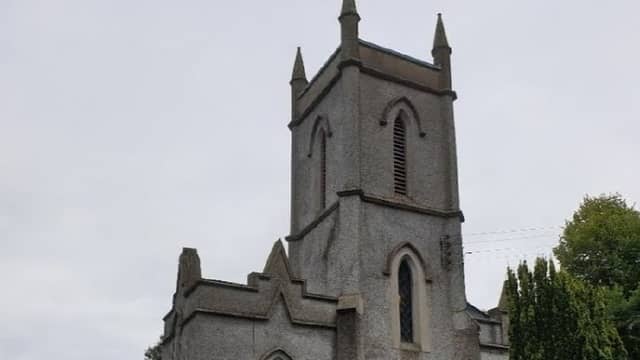

A DISCOVERY of eight graves thought to belong to members of the Knights Templar in Staffordshire has been described as ‘one of the most nationally important discoveries’ of its kind. Historian Edward Spencer Dyas had already found the resting place of three members of the ancient order at St Mary's Church in Enville, Staffordshire, but has now discovered five more 800-year-old graves.
A DISCOVERY of eight graves thought to belong to members of the Knights Templar in Staffordshire has been described as ‘one of the most nationally important discoveries’ of its kind.
Historian Edward Spencer Dyas had already found the resting place of three members of the ancient order at St Mary's Church in Enville, Staffordshire, but has now discovered five more 800-year-old graves.
He believes the medieval structure could be one of the most nationally important Templar churches in the UK.
Each of the graves he has uncovered features a Templar cross within double circles in a standard Templar design.
One also includes a Crusader cross, suggesting the knight was both a Templar and a Crusader of the ancient military order.
At the foot of the same grave there’s also a Templar Cross - a variation of the Jerusalem Cross - revealing the unknown knight had once been part of the Templar Order at Temple Mount, Jerusalem.
Experts have hailed the major discover and say ‘many more’ could be hidden around the UK.
Tony McMahon, a historian, author and Templar expert, thinks the relevance of the graves has remained unknown for around 500 years.
“It does beg the question – if Enville has revealed its Templar dead, how many more graves are lying under layers of clay?”
St Mary’s Church could have been one of hundreds of Templar churches, McMahon said, adding that members would have been buried with the order's sacred insignia on their tombstones.
Other important landmarks in the history of the Templars include Rosslyn Chapel, in Scotland and as the name might suggest, good old Templepatrick.
The Catholic military order was founded in 1119 and within two decades it was recognised by the Pope - and it is not difficult to see why.
With the Bible in one hand and a sword in the other, they were useful friends to have as western pilgrims began to visit the Holy Land.
French knight Hugues de Payens approached King Baldwin II of Jerusalem and Warmund, Patriarch of Jerusalem, and proposed creating a ‘monastic order’ for the protection of these pilgrims.
The King readily agreed and granted the Templars a headquarters in a wing of the royal palace on the Temple Mount in the captured Al-Aqsa Mosque. The Temple Mount had a mystique because it was above what was believed to be the ruins of the Temple of Solomon - hence the name.
And their selfless benevolence proved to be rather profitable. Soon they were receiving money, land, businesses, and noble-born sons from families who were eager to help with the righteous fight. God’s army had become soldiers of fortune.
With their improved circumstances their influence quickly grew.
The Templars were often the advance shock troops in key battles of the Crusades, as the heavily armoured knights on their warhorses would set out to charge at the enemy, ahead of the main army bodies, in an attempt to break opposition lines.
One of their most famous victories was in 1177 during the Battle of Montgisard, where some 500 Templar knights helped several thousand infantry to defeat Saladin’s army of more than 26,000 soldiers.
“A Templar Knight is truly a fearless knight, and secure on every side, for his soul is protected by the armour of faith, just as his body is protected by the armour of steel. He is thus doubly armed, and need fear neither demons nor men,” wrote Bernard de Clairvaux.
But their power created enemies too - and by the early 14th century, with the Holy Land lost, some believed it was time to put the Templars out to pasture.
Salacious rumours about the Knights’ secret initiation ceremony fuelled distrust, and King Philip IV of France – deeply in debt to the order – took advantage of this to destroy them and erase his debt.
In 1307, he had many of the order’s members arrested, tortured and burned at the stake. Pope Clement V formally disbanded the order in 1312 under pressure from King Philip.
The Knights were no more, but their legend continues to resonate. What became of those fighting men - and what happened to their gold?
This week the Antrim Guardian looks back at the local links, and there are many.
Castle Upton in Templepatrick was built on a Monastic site. Before construction began the site was covered in ‘raths’, enclosures and a mixture of other buildings.
A holy well had been recorded too and it is regarded a national monument potentially associated with a medieval church and graveyard. But what kind of medieval church or complex?
The OS survey memoirs in the 1830s may offer some clues.
‘Some of the old inhabitants assert that they remember the foundations and fragments of the walls of the ancient church or temple which was erected here by the Templars, or more probably by the Knights of St John, in the 14th century and dedicated by them to St Patrick.
‘The temple is said to have stood near the holy well at the centre of the village.
‘At the eastern end of the village is a very old burial ground, which within the memory of some old people contained the foundations of a church, said also to be of the Knights of St John.’
This site is not mentioned in the Papal and Diocesan taxation previous to the plantation period and after 1306.
This was because it was exempt for Papal power as it was part of the Hospitallers (Order of St John of Jerusalem).
Of course there is another glaring clue in the name. When a town or area has ‘Temple’ prefixed in front of its name if most often in relation to a military order of Monks which was set up in that town. The Knights of St John were set up in 1099 and are still an active order today.
Named after John the Baptist they were to provide care for the sick, poor or injured pilgrims. They are no longer active in Templepatrick, any remnants disappearing in the late 1800s.
Back in 1878 O’Laverty recorded that the church at Templepatrick ‘stood in the graveyard but not a trace of it now remains’.
‘It belonged to the Order of St John of Jerusalem (otherwise known as the Hospitallers) and was therefore exempt.’
During the reformation the Knights were suppressed across Europe however in Ireland this did not happen until Sir Arthur Chichester made it his aim to push his influence across to Antrim in the early 1600s.
In the mid 1500s there was two missions led by the English of Pale to throw out the Scottish Plantations into the north of Ulster (The third plantation being the joint ‘Plantation of Ulster’).
These two missions failed miserably being pushed back with their tails between their legs. What they encountered was the fighting Scots led by warrior Monks.
When Chichester advanced he had to break the power of the church. Muckamore was the main monastic complex in the area, subjecting the whole area forming an area similar to the Pale around Dublin.
This site became very rich, branching out and establishing the Monastery in Antrim town. Today this is under the car park of the Antrim Forum, though it is very clearly pointed out in the Ordnance surveys.
A letter from Sir Arthur Chichester to Dublin state that he killed all the nine warrior Monks in Antrim. Chichester left no one alive in the whole complex.
In recent years when the new road through Antrim was being built work had to be halted - the monks had been discovered, rather well preserved and still wearing their robes, which shone red after so many years under the ground.
It must have been a spectacle when the bodies were lined up beside Antrim High School that day.
The remains were late taken away by Queens University for study in their School of Archeology.
Back to Templepatrick, it was probably established long before the formation of the Templars or Hospitallers as an old Catholic Church complex.
When the Normans came into Ulster in the late 1100s they were partially successful but in the end pulling back, establishing Carrickfergus and building the castle there.
The Church was then also similarly invaded.
The Templars came as the Priests of the newly aligned Irish and English Catholic church. The village was then changed establishing the new Templepatrick.
These new priests did not have the opposition directed towards the Normans.
As before, they came to Ulster with a Cross in one hand and a sword in the other. This created a religious area in Ulster, controlled by the clans but under the control of the church.
It is no secrete that some of these Clan leaders went off on Crusades recruited by these Templars in charge of their most secret sites.
1312 saw the banishment of the Templar order at the Council of Vienna.
The Church complex in Templepatrick was at this time exempt from taxes and under the Order of Hospitallers, meaning it was not subject to Papal taxes.
From 1302 to 1306 it is clear that Templepatrick was under Norman subjection.
It was not known as Templepatrick in the Papal tax but as the area belonging to a Norman called Hugh de Logan called ‘vill of Hugh de Logan’. Hugh probably then dedicated his lands to the patron saint Patrick and so his Church became Temple Patrick.
From 1306 to 1600 the riches poured in, Hospitaller Templar castles were erected in Killinchy called ‘Old Jerusalem’ and such like.
Other sites like Templepartick and Mallusk in 1607 were still receiving disproportionate amounts of taxes, which went straight into the Knights Hospitaller funds.
The rest of Ulster did not escape from this Church Templar incursion. In Dungiven a priory was built, and not far from there are still standing Double Cross Templar Graves.
Sir Arthur destroyed this ‘Warrior Church’ and spilt up their lands, selling them to different families such as Thomas Welsh and the Rowley family.
The Castle at Templepatrick was given then to the Humfrid Norton family.
With the success of the Plantation the memory of the Templar and Hospitallers faded.
The old Church system was destroyed and the Presbyterian church rose to prominence in the area.
The Knights were ultimately defeated - but you can’t keep a good story down!
The website of St Patrick’s Church in Templepatrick further explains: “The church of Patrick may have existed from the 5th century in this part of the Six Mile Water valley. The Holy Well at which converts were reputedly baptised by Patrick was still in existence in the early 20th century.
“The Castle of the Knights of St. John of Jerusalem occupied the site of Castle Upton from the thirteenth century until the Reformation.
“It was the principle monastic priory of the diocese, controlled by the Ards Preceptory of St. John. This military order of monks - originally known as Hospitallers (after a hospital in Jerusalem dedicated to St John the Baptist) and now known as the Knights of Malta - served as Knights Templars in King Edward's Crusades in the Holy Lands. Only the cemetery containing the Mausoleum of the Templetown family remains today.
“The present parish church in Templepatrick was originally dedicated to St John, possibly because of the association with the Knights of St John.
“The dedication was changed in 1886 by Bishop Reeves and it became St Patrick's. Consecrated in 1827, it was built at a cost of £830, a gift from the Board of First Fruits.
“In 1889 a new chancel, East window, vestry room and organ chamber were added and at the West end of the building a baptistry, choir vestry and porch. This was possible through the generosity of members of the Templetown family. All these improvements are recorded as having cost £900.
“From 1898 the Rector was responsible for the adjoining parish of Donegore, although the union of the two parishes was not official until 1922.
“St Patrick's church contains a fine Haighton organ built between 1849 and 1858, and an interesting brass font which originally belonged to a church in Sebastopol on the Crimean peninsula.
“Restoration work was completed in 1993 after an extensive outbreak of dry rot was discovered. During the restoration some faint traces of a large mural were found on the north wall, and also uncovered were wrought iron roof arches similar to those in other churches built in the early 19th century.”
Castle Upton itself also contains a mausoleum and crypt.
The stately home was once in the hands of the de Burgh-Kinahan family and was most recently vacated by Danny Kinahan, former South Antrim MP and now Victims’ Commissioner.
And in Samuel Lewis’ ‘A Topographical Dictionary of Ireland from 1837, he described: “In a field at a short distance from the mail road to Antrim is Cairn Graine, a remarkably fine monument of antiquity: it consists of ten large tabular stones, supported on upright pillars in the manner of a cromlech, but ranged in a straight line of 41 feet in length in a direction from north-east to south-west; the stone at the north-eastern extremity is rather low, and every succeeding one increases in elevation towards the southwestern extremity, where the tabular stone is of very large dimensions and supported on five upright pillars.
“Various conjectures have been entertained as to the origin of this interesting relic; the name literally implies ‘the Heap of the Sun’.
“Not far from this heap is one of the mounds or forts so frequently found in this country; it appears to have been very extensive and of great elevation, but has been much diminished and disfigured by the removal of the sand, of which, intermixed with common field stones, it was originally formed.
“Near Dunadry is a very perfect circle of large stones, and there are several other raths in the parish. This place gives the titles of Viscount and Baron Templetown to the Upton family.”