

The beginning of the end for Holywell as locals get a glimpse of plans for new facility
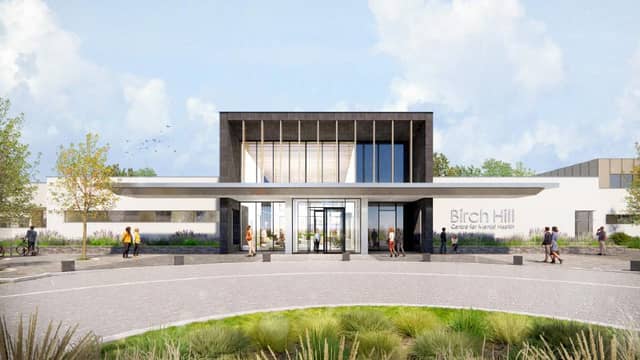

THE era of the asylum is officially over. Last week the Northern Trust held a consultation event in the imposing surroundings of Holywell Hospital - to let people know about the plans to finally replace the monolithic facility..
THE era of the asylum is officially over.
Last week the Northern Trust held a consultation event in the imposing surroundings of Holywell Hospital - to let people know about the plans to finally replace the monolithic facility..
Holywell Hospital, on the outskirts of Antrim town, dates from 1900, when it was built as an asylum to designs by John Lanyon, son of Sir Charles Lanyon.
It was John’s last work before his death, coming just a year after his father's. It was subsequently extended in the early 1900s, with the new wings consistent with the early design. The complex has always operated as a mental health facility.
The Victorian red-brick has traditional period detailing of projecting brick courses, corbels, and plinths. This is complemented by traditional slate roofs which include feature towers and turrets.
But over the years, as the treatment of people with mental health issues has changed, the sprawling complex has become increasingly unfit for purpose.
Whilst no doubt impressive to look at, the listed status of many of the buildings, including the famous clock tower, adorned with gargoyles, means there is very little room to move in terms of physical improvements. The proposal to replace Holywell comes in the shape of plans for the new Birch Hill Centre for Mental Health on trust-owned lands south of Antrim Area Hospital.
The proposals would centralise Northern Trust Mental Health services within a modern Centre for Mental Health (CMH) comprising 134 single bedrooms, staff and visitor facilities, management and operational spaces, external landscaping and gardens and car-parking, as well as servicing facilities.
The proposals also provide an ideal setting for treatment and recovery, within a centre designed to be considerate of neighbours.
The Northern Health and Social Care Trust provides a range of health and social care services to a population of approximately 479,000 people across a geographical area of 1,733 square miles, making it geographically the largest trust in Northern Ireland.
Statistics show that Northern Ireland has the highest prevalence of mental health problems in the UK, stemming from both the legacy of the Troubles and a range of wider socio-economic factors (Department of Health, Northern Ireland Mental Health Strategy 2021-31).
Dealing with this pressing issue requires bold steps and substantial investment, as set out in Northern Ireland’s Mental Health Strategy 2021-31. This strategy outlines a funding plan to create three new Mental Health Inpatient units to deliver state-of-the-art therapies and treatments.
The new Birch Hill Centre for Mental Health will be one of these projects - by providing new, purpose-built accommodation, the Northern Trust says it will be able to ‘build a world-class service to benefit people right across the Trust and the wider region’.
The Trust said that existing Trust Mental Health provision at Holywell Hospital and Causeway Hospital (at the Ross Thomson Unit) have served the community well - but that ‘neither building supports the delivery of excellent mental health care and in order to enhance our service they will both be relocated to the Antrim Hospital site’.
The Centre for Mental Health will provide assessment and treatment to people 18 years of age and over who are experiencing acute mental illness. The new facility will offer single bedroom, modern, fit for purpose facilities for these patients.
The Trust said: “Safety is of paramount importance in all of our healthcare settings. We strive to provide people who need our services with high-quality care in a way that is respectful and safe. Our staff are highly trained and skilled and safety for all is a key principle in design of our new hospital.”
Consultation is now underway with local people, including some residents of Bush Manor, where five homes will face directly onto the new facility, should planning permission be granted.
The pre-application event took place in the Ewart Room in the main Holywell building last Thursday.
Should planning consent for the new Centre for Mental Health be secured, the tender for the construction work would be advertised towards late 2024, with award of contract anticipated for mid 2025. This would be followed by an anticipated two-year construction phase, currently resprenting an £86-89m investment, with a preliminary target for handover in mid 2027, followed by a six month Trust commissioning period.
The main entrance will face towards the north of the site and wards and bedroom will be arranged around the outside of the buildings, with windows facing outwards.
The Trust says that extensive landscaping and fencing work on the boundary with existing homes, as well as the fact that all inpatient accessible areas will be on the ground floor of the buildings, will safeguard neighbour privacy and ensure no overlooking. They added that the current boundary has been upgraded with a new fence in keeping with the fencing used elsewhere on the Trust site, with landscaping internal to the boundary.
This aspect of the development was taken forward first, to ensure that the new planting on the boundary has a chance to mature before the centre for mental health becomes operational, ensuring the boundary is clearly demarcated and ensuring privacy for neighbouring residents.
The upgraded boundary and landscaping has been designed to ensure that it will not afford the possibility of becoming a thoroughfare.
The Trust has also instructed ecologists to carry out studies which will give a clear understanding of the site’s habitat potential and it will undertaking full mitigations based on their recommendations to compensate for any loss of habitat.
Sharon Ward, head of capital projects with the Trust and project lead for the Birch Hill Centre, said that the new facility is part of an overall half a billion pound plan for the whole Antrim Area Hospital site, which will include improved womens’ and childen services, lab services, permanent new wards, new theatres and better ICU services.
Sharon said that anyone visiting, living in or working the current buildings will know that the site has outlived its purpose.
“The buildings are beautiful in their own way and very of their time, but the era of the asylum is long gone and there is less stigma surrounding mental health.” she said.
“The new complex will be much more welcoming and light, there will be a lot of open and green spaces and views across the countryside, which will enhance the wellbeing of residents and staff, the main building will be open to the public and there will be a cafe. The fabric of these old buildings is not suited for modern use and not in a healthcare setting.
“And of course the feedback we receive from local people at this event and throughout the consultation process will be used to inform our plans for the new facility.
And once the residential clients of Holywell have moved out - what will happen to the site, for so long a huge employer and landmark in Antrim town?
“At the moment we are working on a plan,” said Sharon.
“As well as the residential clients, there are also a lot of other departments working here, including important services like HR. We will look at decanting those workers into other properties. But what we do here with this site will help fund the costs of the new hospital so sooner or later, all Trust involvement with Holywell could cease.
“The Department of Health and the Trust are looking to involve all relevant parties to come up with a plan.
“Obviously so much of the site is listed, that it limits what can be done with it, but the buildings and the ground are so impressive and important to the people of Antrim, that a use which is acceptable to the community here is very important to us.”
Meanwhile, the Trust has also proposed alterations to Carrick 4 Ward at the current Holywell hospital, with associated works within the ward including replacement ceilings, upgrade of electrical infrastructure and mechanical ventilation system and installation of wall vents. All works will be confined to the ground floor, according to documents lodged with Antrim and Newtownabbey Borough Council’s Planning Department.
A supporting statement explained: “The works site is the existing Carrick 4 ward, which projects as a gabled wing from the main hospital complex.
Currently the ward is unoccupied, with one single room closest to the main complex used as a manager's office. The main items of the proposed work include replacement upgrade of the existing mechanical ventlatilon system throughout the ward, which is ineffective and ‘no longer complies with Health Technical Memoranda’.
There will also be a replacement/upgrade of existing lighting, with new modern lighting to provide an enhanced patient environment. There will be provision of new wall vents to the elevations to accommodate the new mechanical air conditioning system and new ceiling finishes to the areas affected.
Many local people have strong connections to the site. Former SDLP Mayor of Antrim, Oran Keenan, was born in 1955 and brought up at Holywell Farm.
Culnafeigh Green has since been swallowed up by the Springfarm estate, but back then it was 12 semi detached houses, six on one side of the green and six on the other, occupied by Holywell Hospital staff and their families.
Antrim is often described as a garrison town, but it is also a hospital town - back then there was Holywell, Muckamore and Massereene.
“The green itself was basically a sports pitch, and Bobby Fullerton was the master of ceremonies, the referee and the umpire,” said Oran back in 2018.
“There was a lady called Mrs Barr who used to make clothes, every child on Culnafeigh Green had the same tweed jumper!
“And there were ward sisters, who were actually sisters, the Gallaghers, who would bring all the children grey shirts and socks and pants.”
In 1977 Oran also went into nursing and has seen a lot of changes in the care received by people with mental health difficulties.
“When I was a boy there was a knock at the side door and there was a man in a dressing gown and pyjamas, he was cut to ribbons,” he said.
“He must have escaped from Holywell, so we brought him into our house and into the kitchen and gave him a cup of tea and I went to the neighbour who had a phone and a short time later the vans arrived to take him back.
“Back then there was custodial care, the nurses were called ‘keepers’. The patients had their clothes taken off them and put into bags.
“Attitudes have changed for the better now, everyone is an individual. Instead of one generic drug or treatment, there are three or four hundred medications alone.
“There was a lot of ignorance and threats years ago, but there is a lot more understanding and a lot less stigma now.”
One of the most famous residents of Holywell was Iain Hay Gordon.
He was convicted of the 1952 murder of a judge's daughter but has always maintained his innocence and insisted police forced him to confess to the crime. In March 1953 he was found guilty but insane of the murder of 19-year-old Patricia Curran. She had been stabbed 37 times in the grounds of her family home in Whiteabbey, County Antrim.
Gordon was sent to Holywell Hospital in Antrim to serve his time at Her Majesty’s Pleasure. It is telling that during his seven-year stay in Antrim he received no treatment for his imaginary condition.
For the first two years he was locked up in a ward with ‘dangerous psychopaths’.
“They could be very nice to you one minute then come at you with a chair the next, through no fault of their own. They were mentally ill,” he later recalled.
“You stand with your back to the wall so you can see everything coming towards you.”
Though he was well-treated by staff, the early days in Antrim were difficult for the young airman.
“I remember it was the Queen’s Coronation and I was very depressed. Then somebody gave me a Daily Express to look at and there was this guy called Norman Vincent Peale who taught positive thinking, and his book was serialised. It turned my life around.
“No matter what your condition is, you can take control. When I was in the hospital, just to keep myself going, I used to say ‘tomorrow I’ll be free’. I kept saying that for some seven and a half years until it became automatic.”
During that time he worked freely in the hospital grounds. Gordon was even known to ride into town on a bike to run errands.
Local man Robert Wilson was a plumber at the hospital during Gordon’s stay, and he recalled that the staff all knew he had been ‘framed’.
“I remember him very well. He was a nice chap, quiet - laid back even,” he said.
“Everyone knew why he was there, of course. There was a fair bit of talk about the case and that. But I don’t think many thought he did it. There were no doubts as far as I was concerned.
“Iain Hay Gordon was framed.”
Mr Keenan knew about the case from an early age through his father, who also worked at the hospital.
“My late father nursed Iain Hay Gordon,” he said.
“He was of the opinion that it was an in house murder but because of who the father was, Mr Gordon was convicted and sent to Holywell where he received no treatment.
“Dad said Iain was very trustworthy.”
Mr Gordon was released in 1960 and finally cleared in 2000, passing away in 2012.
Another local woman contacted the Guardian last year to tell her story.
“Iain was a real gentleman,” said the former nurse. He was spotless, well spoken and very polite.
“No one at Holywell thought he was guilty or capable of murder. He was very helpful, allowed to walk around the grounds but never once tried to run off.
“My late husband also worked at Holywell and sometimes worked in the canteen and Iain would have helped him. Dr Smith was very good to him.
“All of the staff were very fond of him and always followed his case, we were so pleased when he got cleared.”
The former nurse said that she even danced with Hay Gordon.
“Back years ago the dances at Holywell were a big thing, all the big bands of the day would come and perform, those dances were the talk of the town. Holywell back then was like a village or a small town of its own, a real community.
“There was even a band made up of staff - porters, electricians and groundsmen, they had a group. Years ago things were very different, the male staff couldn’t go down past one part of the corridor and the female staff all had to stay on the other side, it wasn’t integrated like it is now.
“Well Iain would dance with every single female staff member. He wasn’t a 100% dancer but he was very respectful. He was a good singer though, he would get up and do a turn, that was something. It wasn’t easy for him.”
The Guardian reader added that she has fond memories of Iain’s mother.
“She used to come and visit him and stay for the weekend. She stayed on a house at the bottom of Fountain Street that used to be a B&B and still to this day I think of her when I pass by. I never remember a father or anyone else belonging to him, but always his mother, shse was so loyal and fought so hard for his name to be cleared.
“I am glad that people still know his name and that people now know he was innocent, certainly everyone in Holywell knew that he was and that should never have happened to him.”