

The day Antrim's most famous literary son was reunited with his beloved mum

AS the first rays of the warm Californian sun found the cracks in the curtains, the housekeeper sensed something was wrong. The master had not roused from his slumber and remained in bed, deathly still.
AS the first rays of the warm Californian sun found the cracks in the curtains, the housekeeper sensed something was wrong.
The master had not roused from his slumber and remained in bed, deathly still.
Dr Alexander Fitzgerald Irvine had quietly slipped away in his sleep surrounded by the comforts that his fame had given him.
His passing, in Hollywood no less, was of course worlds away from where his story began 78-years earlier on the impoverished streets of Antrim.
He was the son of Anna and Jamie, she a Catholic and he a Protestant who ran a modest cobbling business from the small cottage in Pogue’s Entry they shared with their 12 children.
Life was hard and the privations were many.
Irvine later recalled scraping offal from the pavement near a butcher’s shop to get a morsel of meat to quell the all-pervading hunger. He worked as a lad too to supplement the family’s income, taking jobs as a paper boy and even as a scarecrow to earn a few pennies.
But despite the aching poverty, his was a house filled with love. And, ultimately, that was enough.
Blessed with a fierce intelligence, the Antrim man eventually decided to widen his horizons. There was a stint in the navy before he attended Oxford University (1887-88).
Then came the momentous decision to cross the Atlantic, where the lessons of his own upbringing saw him drawn to missionary work with the impoverished people on skid row at the Bowery in New York.
Shortly after he landed, on July 12 1889, came the devastating news that his beloved mother had died back home in Antrim.
He worked on through is grief, answering his new found calling by pursuing further studies at Yale (1900-1904). During his final year there, his father died in Antrim Workhouse - a far cry from a grand home in the Hollywood hills.
Irvine had left that life behind him and he was determined to make the most of the opportunities he had created for himself.
But he did not forget. In 1913 came ‘My Lady of the Chimney Corner’, his immortal tribute to his mother. It was a global smash that cemented his name in the literary world.
There was another side to the Antrim man too. In 1916 Lloyd George personally asked him to become Chief Morale Raiser for the exhausted troops at the western front.
More books and plays would follow, and there were infrequent trips back to Antrim - the last in the 1930s when he paid an emotional final visit to Pogue’s Entry where his extraordinary journey had began all those years ago.
When he finally breathed his last on March 15 1941, plans were soon drawn up to reunite the town’s most famous literary son with his parents, who lay in the grounds of All Saints Church.
The second World War was raging, however, and the long journey home would not be made until July 1946 when his ashes were finally returned to his childhood home.
And given his celebrity, reporters were out in force to record a town coming together to mourn the loss and celebrate the remarkable life of one of their own.
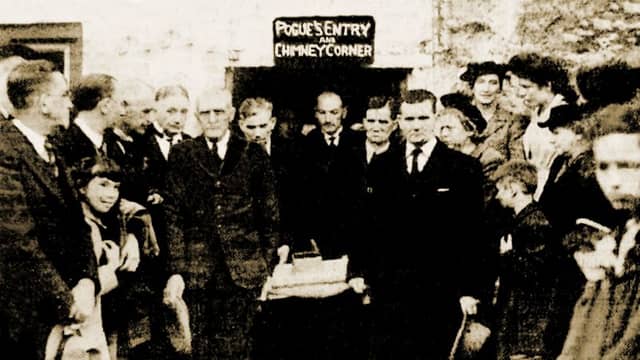
It was a Saturday afternoon and the gathering overflowed from the narrow cobble-stoned entry onto Church Street. Ears strained to hear, and it soon became clear that the service would centre on Irvine’s abiding memory of life in that simple homestead.
“Love suffereth long and is kind; love envieth not; love vaunteth not itself, is not puffed up... Love never faileth...”
Those were the words read aloud as the tiny casket containing the precious ashes were carried on their final journey.
Rev RS Craig and Rev William Mitchell conducted the simple service - and among those in attendance was Mrs Margaret Scott, Dr Irvine’s sister.
The house itself was little changed since their childhood days. The china dishes still sat on the ledge above the chimney corner, the roughly constructed nursing stool sat close to the fire place and the small clay pipe lay snugly in the recess.
But there were some adornments too, including an ‘excellent’ oil painting of Dr Irvine. And there, on the wall near to where Anna had once sat was another picture, depicting a poor woman working the land.
It had been purchased by Dr Irvine in the United States and it was by famous French artist Jean Francois Millet.
His works now hang in museums around the globe and are much sought after by private collectors. Rough sketches can go for over 12,000 dollars. In 2014 one of his paintings went under the hammer for $1,985,000.
His parents could never have dreamed that such a treasure would hang at Pogue’s Entry. Realising its worth, the council have long since removed the painting and put it ‘into storage’.
People from all walks of life were there too, including shopkeepers who closed early to pay their respects.
After reciting the Lord’s Prayer, the procession made its way to All Saints, with Irvine’s nephews - Harry Adams, Thomas Alexander and William Scott - carrying the great man’s remains on a small purple coloured bier.
The service in the church opening with the singing of ‘How Bright Those Glorious Spirits Shine’, after which the Vicar of Antrim, the Rev SP Kerr, read the Order for the burial of the dead, which was followed by Psalm 23.
The lesson was read by Rev William Mitchell and afterwards came the hymn ‘Be Thou My Vision’ to a fine old Irish tune.
The Bishop of Down and Dromore, the Rev WS Kerr then gave the address.
“It is fitting that the ashes of Alexander Irvine should mingle with Antrim earth in the grave where his mother and father lie,” he said.
“He was, in his generation, the most distinguished son of this town. By his aspiring courage and fortitude he rose above the penury and illiteracy of his youth.
“Few men can have had a more severe or prolonged struggle.
“Our admiration goes out to Irvine, not only for the ability and determination by which he broke his birth’s invidious bar, but for his faithfulness to high ideals.
“He did not devote himself to the acquisition of wealth or station. Less brilliant, less cultured men than he have done that successfully and with the world’s applause. He gave himself to the unselfish service of man.
“A newspaper boy on the streets of Antrim, scaring the birds from the farmers’ fields, a stable boy, a coal miner in Scotland, a marine with the Gordon Relief Expedition.
“In America, a porter, liftman driver of a milk cart, sales man, a mission worker in New York’s worst slum for many years, a Congregationalist minister, a farmer, a diocesan lay reader, an actor in a religious play, a lecturer to the forces in the Great War.
“He succeeded in passing through Yale University, studying his Greek grammar as he went up and down in the lift he had charge of. As a lecturer and orator he was in the front rank. His books have won him widespread fame.
“All the powers of his unique personality were spent for the social and moral betterment of the afflicted and the downtrodden - the victims of their own folly or of unpropitious fate.
“He never forgot the sore needs of the class from which he sprang. He has given vivid pictures of his experiences in two of his books, ‘The Souls of Poor Folk’ and ‘From the Bottom Up’.
“’The Carpenter and His Kingdom’ reveals the living inspiration of his restless, crusading life. He saw all men as his brethren in Christ.
“He shared the bygone brutal conditions under which foreign or pressed labourers worked as lumbermen or miners in remote parts of America and by his articles exposing the iniquities contributed to the abolition of such evils.
“Always he exalted the spiritual values - life could only be readjusted under the Kingship of Christ.
“It is because of another book of his ‘My Lady of the Chimney Corner’ that his name is best known and that we are here today to honour his memory.
“By his literary genius and his glowing love, Alexander Irvine has touched innumerable hearts with his story of the fine-souled heroic woman, the mother of 12 children who endured such crushing, relentless poverty. Few finer tributes have been paid to a mother.
“The book reveals how nobly a steadfast mind can rise above the appalling distress - how the failure of every hope, the closing of every door can bring sympathy and sweetness instead of despairing bitterness. It shows how an innately beautiful spirit can bloom in the most adverse, depressing conditions.
“It preaches through the life and lips of Anna Irvine the Gospel that the world needs - the teaching of Jesus Christ simply, honestly, applied in daily life.
“Many of her sayings should be as treasured as that which was the keynote of her life and is now inscribed on her tomb. ‘Love is Enough’.”
The Bishop also quoted Dr Irvine’s own reflection on his early years.
“We never owned a chair. The mud floor never had the luxury of a covering, nor did a picture ever adorn the bare walls. Yet her natural refinement of spirit is lit up by her favourite dictum ‘It’s nice to be nice’.
“A coffin had to be begged for her funeral yet on her death bed she said to her husband ‘our crock of love was never drained’.
“Of all the people who had lived in Antrim as long as she had, she was the least known. Obscurity was her portion in life.”
But not for long...
Now, said the Bishop, that ‘poor abode’ in Pogue’s Entry was a shrine to her memory.
“The walls that never had a picture carry one of the masterpieces of a world famous artist. The obscurity has vanished because the son she trained has compelled the world to understand the glory of her life of love, of her gallant spirit and of her inspired sayings.
“In him was the recompense for all her unrealised hopes and most of all she rejoiced because she lived to know that he was a man ‘that loves the poorest creatures on earth and serves them’.”
The service over, and Alexander Irvine was finally reunited with her in the churchyard.
A wreath placed on the grave by J Herbert Ireland read: ‘We salute the memory of a great Irishman who for all the money in the world scorned to sell a slice of his soul’.
There were few to bid farewell to young Alexander Irvine when he had left many years before. But on that summer’s day in 1946 hundreds were there to welcome him back - to welcome him home.