

The day Nancy Bags made a surprise appearance at her own Irish wake...

IMAGINE being judged purely by how you look - your entire worth as a human being decided by that face. That walk. That disability. Most would rightly perish the thought. Not me, they would say. You can’t judge a book by the cover.
IMAGINE being judged purely by how you look - your entire worth as a human being decided by that face. That walk. That disability.
Most would rightly perish the thought. Not me, they would say. You can’t judge a book by the cover.
But people can be cruel, and the archives are littered with sad stories of people shunned for simply being different.
A visit to Antrim Petty Sessions back in the summer of 1903 put the spotlight on the challenges of living with physical disability in those less enlightened times.
Takes James Mooney, for example. He was charged with drunkenness after he was found lying on a footpath in Antrim in a ‘helpless condition’.
He was, the court heard, ‘legless’ - which was unfortunate because he also only had one arm.
Despite that, he had come to town that day seeking work at the hiring fair, but was drowning his sorrows when there were no takers.
Given his predicament, Mooney implored the Bench to give him ‘a chance’. If he was freed, he added, he would ‘leave the town at once and never again visit Antrim’.
His offer sparked laughter in the courtroom and he was released with a caution.
Next into the dock was James O’Flynn, an ‘eccentric-looking individual’ who had just spent a night in the cells - charged with possession of a scary face.
Sergeant Hook stated that there had been frequent complaints at the station regarding the prisoner’s conduct.
With a straight face and unfaltering voice, the officer told the court that O’Flynn ‘appeared to be addicted to the practice of terrifying women and children’.
A few days previously on Station Road, a lady and three children had crossed his path - and were so unnerved by the experience that they raced directly to the police ‘in a condition of nervousness and extreme terror’.
But ugliness, even then, was not a criminal offence, but since a complaint had been made the local man was arrested - though Sergeant Hook admitted that he ‘regretted’ bringing a person ‘so afflicted in body’ to the attention of the courts.
For his part, the accused said that he had not set out to frighten anyone. Quite the contrary, he said that children constantly harassed him, mocking him and throwing stones.
He was released with a ‘severe caution’ and the police were told to keep him under observation and, if necessary, they should prosecute him for vagrancy. Charming.
But it could have been worse. Two hundred years earlier an Antrim native had paid a terrible price for not ‘fitting in’.
The penniless old woman was driven to distraction by the ‘cruel and barbarous’ treatment she received from her neighbours - including an accusation that she was a witch.
To escape their constant jibes, the woman sought refuge in a small, damp cave near the Old Meeting House in the town. But this self-imposed exile did nothing to quell the rising tide of resentment. Indeed, for some her decision to ‘life like a wild animal’ only confirmed their suspicions.
It was to become a case of out of the frying pan and into the fire. She was dragged screaming from her makeshift home and stabbed to death. Her body was then torn asunder, with much of it thrown into a bonfire and the rest scattered over places she was supposed to have exorcised her evil influence.
But death was not the end of her public humiliation. For years after her death her ghost, in the form of a goat, was said to haunt the Meeting House. It was popularly known as McGregor’s Ghost, after the saintly sexton who had played a key role in her grisly demise.
Threats of a nocturnal visit were used to chasten naughty children. The irony, of course, was that Antrim’s own ‘bogey man’ was guilty of no other crime than looking the part.
But occasionally there was something akin to kindness.
This is the story of Nancy Bags, who lived in a run down thatched cottage between Antrim and Randalstown in the mid-1800s.
She did not have her sorrows to seek. She was bent practically double, and was unable to stand upright or straighten her back.
Nevertheless, Nancy had a daily routine and would leave her humble home each day carrying a sack into which should place anything - potatoes, fruit, rags, scraps of metal - that she spotted on the road.
There was no welfare state, no doctors, no nurses. Nancy had been dealt a poor hand in life, but she had to play it as best she could.
One day someone realised that the old woman hadn’t been around for a couple of days, so a neighbouring farmer called at the cottage to see if she was alright.
Peering into the gloom he saw her seated in a roughly-made chair. She was quite dead, and had been for a day or more.
Word soon spread across the district and it was agreed that ‘poor Nancy’ should not leave this world without a fitting send-off.
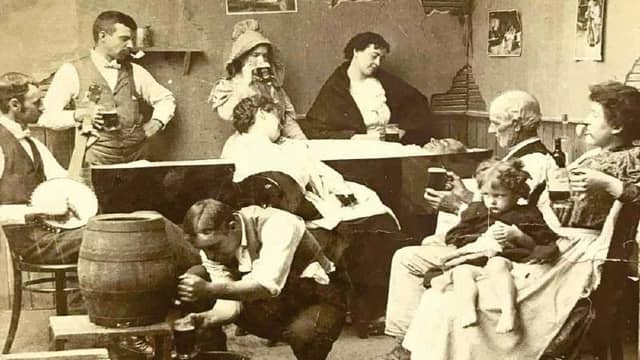
There would be a wake. A traditional Irish wake, which was far removed from the gatherings today, where tea and sympathy are served up with cake and egg and onion sandwiches.
The dearly departed was laid out on a well-scrubbed table in the kitchen - and family and friends were invited to raise a glass in their memory.
Inevitably, these often descended into drunken affairs. It was a time for dancing and merry-making and many a risque story was told to bursts of raucous laughter in the very room where the deceased was laid out.
In time, the clergy began to speak out against the tradition. This was a solemn occasion and should be treated as such. Gradually the wake became a more sanitised affair - a time to reflect on the life of the person who had gone to meet their Maker.
But Nancy’s wake would be done the old way.
Her neighbours tidied up the house and then considered how they would lay out the remains of a person with such long-standing disabilities. The answer was with great difficulty.
Even in death it was practically an impossibility to place the body in a flat position. However, at last, through considerable attention being devoted to cords and ligatures, the desired effect was achieved.
And then the drinking began.
Among the ‘mourners’ was a certain Jemmy Irons. He was a notorious jester - the joker of the district - and he decided to make sure this was a wake no-one would forget.
When the party was at its height and the company was ‘eating, drinking and carrying on’, Jemmy nonchalantly eased himself into position by Nancy’s body.
And then, quick as a flash, he whipped out a sharp pocket knife and, unseen by anyone, slashed the ligatures.
Immediately, to the understandable horror of those in the room, the body contracted and Nancy silently rose into a sitting position.
Women and men rushed from the room at the sight.
Few, it was said afterwards, who witnessed Jemmy Iron’s handiwork that evening ever dared attend another wake - unless it was Jemmy’s own!