

The end of the world? Keep August 17 free in your diary...

WHEN the old church bell tolls on Donegore Hill on August 17 it would be wise to prepare to meet your maker... You see, that sound would herald dooms day - the end of the world as we know it.
WHEN the old church bell tolls on Donegore Hill on August 17 it would be wise to prepare to meet your maker...
You see, that sound would herald dooms day - the end of the world as we know it.
Well, that’s what the country folk living around Donegore, Parkgate and Doagh were led to believe at any rate.
And it was, of course, an elaborate hoax.
It would be all too easy to chuckle at these simple folk who allowed the wool to be pulled over their foolish eyes 150-odd years ago - but that would be doing them a grave disservice.
If anything, these were bright people.
Take Doagh, for example. Today it may be best known for its holestone, which for centuries acted as the area’s answer to Gretna Green. The betrothed merely had to clasp hands through the hole and the job was done.
But it also has many other lesser known claims to fame.
Did you know, for example, that it was the site of one of the Moravian Churches in Ulster?
The very first Sunday School in the British Isles began there too, launched in 1770 by William Galt. It would be another decade before Robert Raikes pinched the idea and introduced it to England.
Doagh was also famous for its book club at a time when the written word was aimed squarely at the privileged few. The authorities viewed it with suspicion. Knowledge was a dangerous thing, so in time a troop of soldiers was dispatched to destroy their little library.
In Doagh Foundry, founded by John Rowan, the first threshing machine was made. They also built the first mechanically-propelled vehicle which Mr Rowan proudly steered down the village street in his very best tall hat.
These were smart people, but they had one chink in their armour. They took folk at their word - and that perceived gullibility was gleefully exposed by pranksters.
It has been said that there are more cats in Parkgate per head of the population than in any other village in the County of Antrim.
Why? Possibly because the ‘hoax of the century’ in the early 1860s.
Parkgate at the time was considered ‘the most exciting village in the whole of the county’.
‘Something was always happening there, particularly in the winter when the days were short and there was not much to do on the land and the young fellows were always up to some mischief or other’, wrote one reporter in 1941.
The worst of them all were Tommy McNiece, a farmer’s son, and Tommy Aitchison, a blacksmith.
And together they hatched an audacious plot to infuriate, but ultimately amuse, their neighbours.
One morning in February locals awoke to discover notices plastered on trees and fences across Parkgate. They were everywhere, appearing in Antrim, Templepatrick Donegore, Doagh and further afield.
It read: ‘I will attend at the Courthouse in Parkgate on the 7th February to purchase cats for the Peruvian Government. From 10s to 15s each will be given according to their colour and quality’.
That’s about £60 in today’s money - a tidy sum by any standard.
Bearing in mind that cats abounded in the district at the time, there was potentially some serious money to be made.
There was hardly a house without at least one, with farmers keeping three or four to keep the rats at bay.
Hook, line and sinker
It appears that as news of the Peruvian Government’s generous offer spread, the locals ‘swallowed it hook, line and sinker’.
The result was that on the morning of February 7 people from across the district carrying their cats in boxes, baskets, in carts, traps and gigs or simply in their arms descended on the Courthouse in Parkgate en masse.
Irish antiquarian Francis Joseph Bigger skillfully set the scene.
“The dawn of the fair had not broken before the traders, fair and otherwise, began to arrive, whether it was herself from Browndod in her heavy go-to-meeting boots - at home she was more comfortable in her everlasting stockings - with a stout basket on her arm which swayed from side to side like gamecocks in a sack on a pedlar’s back having all the appearance of life in it - that was the home puss on its one and only journey in life, with Parkgate the terminus.
“Here and there herself was joined by one and two until a clump was gathered as if they were making for First Donegore on a Sunday morning quite as serious looking with a bright lurking suspicion however in the eye that they were going to receive and not to part with this world’s gear.
“Old men with gathered-up sacks came down the Mote Road somewhat suspicious of each other for fear that there might be a glut in the market, and were met at Agnew’s Corner by others tramping up from Templepatrick village, where all was trim and neat and stray cats did not abound except about the Poor Row. My Lord’s gamekeeepers saw to that.
“Still the price was seductive and the credit short, so the sacrifice was made with the comforting solace that ‘there was plenty more where they came from’.
“Young strappers from the spinning mills of Ballyclare pushed each other around the corners of Doagh, out-rivalling the villagers in ribald talk.
“The old howdie woman from the Four Mile Burn was early afoot with her black triplets in an arm basket. She had sat on a creepie inside her half-door expecting to get a sail on a cart into Parkgate, although it was only short distance, instead of having to travel on foot, for the good dame, like Mrs. Gamp, the nimble of fingers was slow and heavy on her foot.
“Incautiously she opened the lid of her basket to see if all was right, when the most agile of her fry got free and made away through a slap in the fence.
“‘There goes my good 15 bob’, said she. She estimated her stock at top price like most people.
“Then there were others in carts and traps and pannier creels, each holding on to something that was occasionally audible but never musical.
“In they came in dribs and drabs mounted and on foot like Slattery’s Light Dragoons, until there was such a gathering as had never before been seen at any Candlemas Fair in the history of Parkgate.
“Pigs and poultry were pushed aside, old clothes gave place to fresh furs and you would have thought there was a State trial at the Courthouse or some big haul of poteen from Collin Top.
“There was some jostling, of course, and some horse-play, and considerable caterwauling and an odd cat broke from her moorings and there were stampedes of youngsters here and there bent on the recovery of these delinquents, either their own or that of someone else - it mattered not; the fun was good and the chances reasonable.”
Yes, people from 20 miles around had turned out in style to honour to the ‘Peruvian representative’.
“They arrived at the Courthouse all smiles and in the best of spirits, in anticipation of the fine bargains they were going to make, but as the day wore on and the meal-hour came and went and there was no sign of the ‘Peruvian Ambassador’ the smiles began to disappear and the tempers both of the cat-vendors and their charges became a little frayed.
“There were long faces everywhere and cats - cats that snarled and clawed their way out of detaining arms, cats that fought with their owners and with one another, cats that made a thorough nuisance of themselves, and decamped for home and leaving despairing vendors wringing their hands on the Courthouse steps.”
It soon became apparent that they had been duped.
“How the wiseacres, the “I told you so’s” laughed. They had made a joke of the thing from the very beginning; they’d said the whole thing was a sham, and that the ‘Peruvian Government’ was only taking a hand out of the softies of Parkgate.
“How right they were. For it was a sham, a cold, heartless hoax that took the country by storm and set people laughing from Ballymena on the one side to Belfast on the other.
“One can easily imagine the feelings of the ‘softies’ themselves. They were the butt of the countryside and life for them became almost unbearable.”
So much so that they put their heads together and devised a scheme to get their own back on those responsible.
And suspicion at once fell on the ‘incorrigible practical jokers’ McNiece, Aitchison and their henchmen William Ellison, William Jamison and Archibald Ferguson.
There was no hard proof, of course, but it seemed to be the sort of thing they would have masterminded.
Unfortunately for Aitchison the fact that he had just got married singled him out for special attention from the counter-conspirators and when he brought his bride, ‘pretty Kitty Lavery’ home to a little thatched cottage in Parkgate Street ‘the fun began’.
When darkness fell a dozen stealthy figures surrounded the place. The door was tied and bars were silently fastened across the windows.
Then up on the thatched roof climbed a couple of tittering young fellows with, of all things, a creel of cats.
There was loud whisper: “Let them go.” and the next thing was the cats had vanished down the chimney.
Trouble was, the fire was still burning brightly so ‘bedlam broke loose’.
“The scene in the kitchen as the cats came leaping out of the fire, screaming and snarling and spitting, and giving the poor bride the fright of her life baffles description.
“It was a cruel joke particularly for the cats, because at least one was impaled on the chimney crook and was burned to death.”
Well, well, well. That was quite the day!
But the pranksters were not finished yet, though with memories of the fair still so vivid they knew they had to play the long game.
Hooded monks
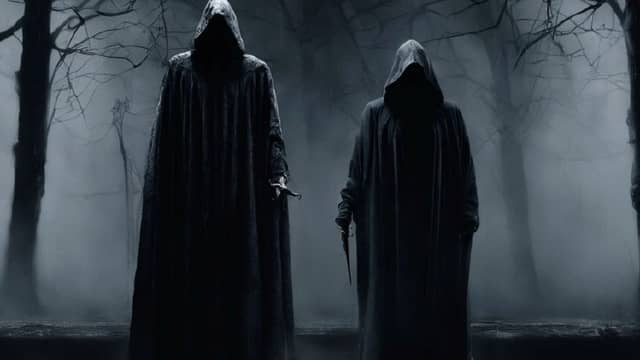
Indeed several years had passed when a pair of mysterious monks wandered into Doagh.
And very soon they made their presence felt - for they were preaching about the end of days.
Bells have had strange uses in their time. The swans at Glastonbury used to ring a bell to summon an attendant. A man who offended against his church was ex-communicated by bell, book and candle.
Parishioners around Donegore knew the sound all too well. Back in the day, a little hand bell was used ‘re-assemble’ the flock for the second sermon of the day.
Between the two sessions, it was the custom of take a light diet of food, and when the service was due to commence the sexton went around the precincts of church - including the inn - and ‘loud in air called men to prayer’.
But it was the old bell at St John’s that was central to the grim prophesies spouted by the monks.
They declared that the world would end on August 17, and that the event would be heralded by clanging ‘without human agency’ from the belfry at Donegore.
As that fateful day loomed large on the horizon, the pair made several increasingly alarming appearances across the district before disappearing again without trace.
And many locals were getting worried.
‘As the fateful day approached the anxiety in the vale of Sixmilewater increased in intensity’, noted one writer.
‘The vague dread of the unknown became more definitive’.
The callers at Beck’s Inn, beside the old fort, became fewer and fewer. Some still scoffed, but none more so that back the landlord.
The weather had been hot and sultry for some time before the appointed day, and as dawn broke on the 17th the skies were blue. During the afternoon, however, a haze top-toed up from Lough Neagh ‘silent as a grey cat’.
But at 10 o’clock the thunder commenced to crash and lightning lit the sky. The skies opened and it was ‘raining stair rods’.
‘The timid and the women and children were terrorised, and even strong men blanched a little’.
And then the bell began to ring. Not the staid peal calling locals to worship, but a ‘mad, spasmodic clang’. It was a ‘sound of terror, even if there had been no monks’ prophecy’.
A few stout hearts ventured to the tower to see who was responsible for the din, and were confronted by a huge black dog.
And that only made things worse. The black dog was often thought to act as a premonition of death. They had even been spotted on the ridge of the thatch at a home where someone was slipping away.
Then Beck arrived, gully knife in his hand. He hastened to the belfry and cut the bell rope, which had been tied to the unfortunate dog’s tail. He knew the animal well - after all, it was his dog.
Yes the ‘monks’ had enlisted the innkeepers four legged friend to carry out their ruse. The storm? Well, that was just good luck.
The hoodwinking holy men were nowhere to be seen. Revenge is sweet.
By now a crowd had gathered and they made for Beck’s Inn to ‘make up in the tavern the time they had lost in the mosque’!
Together they breathed a collective sigh of relief, and quaffed several pints of rather good beer.
The downside, of course, was that they now knew they had work to go to tomorrow...