

‘The Falklands are British - and they must remain that way forever’
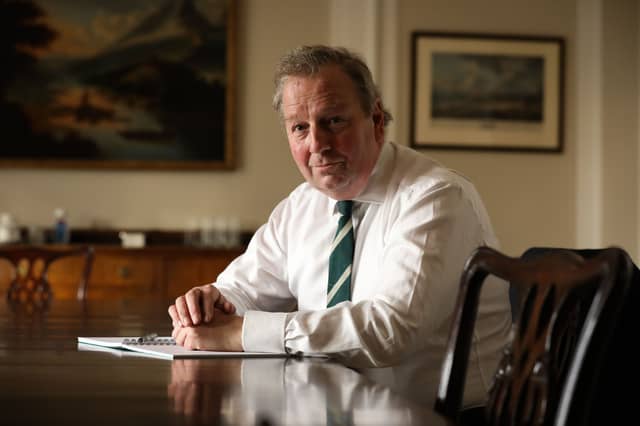

Former Veterans’ Commissioner recalls his time on the islands - and why the ‘appalling’ sabre rattling must end
FORMER Veterans’ Commissioner Danny Kinahan has expressed his ‘mounting dread’ about the potential human cost if the war of words surrounding the Falkland Islands gives way to renewed hostilities.
Recent days have seen a marked escalation in fiery rhetoric from the Argentine Government, who seem determined to test the British resolve that they last challenged in 1982’s catastrophic war.
The conflict lasted just 74 days, ending with their surrender.
Along the way Argentina lost 649 servicemen, while 255 British military personnel perished. Three Falkland Islanders were also killed.
Left unchecked, Mr Kinahan fears that modern warfare could guarantee an even higher death toll if hostilities began again.
“I’m appalled by the events of recent days,” he said this week.
“I’ve been to the Falklands and they are as British as can be. The people there have spoken and they want it to remain that way - and they should be left to live in peace.
“Argentina has no claim on the Falklands. They never belonged to them.
“But now we see this new Trumpian style of politics, when people say deliberately provocative things to see how far it can go.
“But that is a very dangerous game when lives are at stake. We have seen in the war in Ukraine, where thousands of people are being killed and maimed every week, that modern warfare has changed. The killing is on an industrial scale.
“Do we really want to see that again? It’s horrible - and I’m very glad that I’m not a soldier any more.
“The Falklands are a stunning place and the people are British. It should be left that way, forever and a day.”
Four years ago, former South Antrim MP was present at the Royal Arboretum to mark the 40th anniversary of the conflict.
“I felt a bit of a fraud as I was there as a VIP in my role as Veterans’ Commissioner for Northern Ireland when my former Blues and Royals colleagues who had fought all the way through the campaign were not,” said the Templepatrick man.
However, Mr Kinahan did have an intimate knowledge of the islands and its people.
“I spent six months in the Falklands a year after the war as the Officer in charge of running the headquarters and operations room,” he said.
“The Falkland Islands had a population of around 1,800 in 1982, almost all of whom were British families.
“When there I did meet one Chilean family and I think they were the only non-British. Most of the population lived in Port Stanley with Goose Green and Fox Bay the other two main settlements.
“The islands are the size of Wales with large swathes of mainly bald treeless rough grazing land interspersed with ridges of mountains double the size of Slemish but topped with large broken boulders and surrounded by boggy peat.
“When there I had a cross country trials motorcycle and, when off duty, I would explore the surrounding countryside, especially the mountains such as Tumbledown.
“My roster was three days on, three nights on, three days off, meaning I often was free when others were not.
“Occasionally I dismounted unintentionally over the handlebars as I sank in a bog or failed to jump a ditch and, just as often, I broke spokes or snapped the chain on the rocks meaning I had to carry the bike or part of the bike back as I yomped home.
“This gave me a reasonably good idea of the grit and determination that those in the war must have had to have to assault these mountains with perpetual wet feet and the threat of twisted ankles of worse.
“Further dangers included the minefields which were fenced off but clearly marked. There were many stories of how the plastic mines floated downhill in the boggy land and under the fences demanding a certain wariness.
“Those fighting the war did not have that luxury and many appalling injuries were sustained by them.
“The islands have their own weather system and you could plot the rain and sleet storms on a map with the wind speed and ensure you were in cover as each storm passed.
“I was there in spring and summer but the troops there were not that lucky, nor of course did they have the freedom of trials bike for exploration.
“They were facing crack, fully armed troops on top of each mountain, dug in and armed to the teeth, with those same minefields unmarked between them and their positions. Snow, sleet and driving bitter wind was the norm for them.”
And Danny could have been fighting by their side.
“When the task force was put together our troops were previously training with the Parachute Regiment and each were learning how light tanks and infantry could best work together.
“The Blues and Royals were to provide light armoured reconnaissance support and I was told my squadron was to get ready to go. My troop had just won troop tests and suddenly here was a chance to do what we had been training for.
“Holding my school atlas up on the pages showing North and South America I remember the incredulity of my troopers when I pointed our destination at the bottom of the map where the Falkland Islands are. The islands were 7,900 miles away!
“The powers that be decided half way though the training that our light reconnaissance tanks were not needed and were not to go as part of the main invasion force, but to be ready if called.
“It was now our leave period and so we dispersed, only for the senior officers then to decide at the last minute that two troops should go. As my squadron was now away, it was not to be us and, I have to admit, our disappointment was huge. We were still to be first reserve.
“Frustratingly we had been the enemy on the pre campaign exercise in Wales where 5 Brigade - based mainly on the Household Division and the Welsh and Scot’s Guards Regiments - was to practice their skills and prepare for Falklands terrain and weather.
“Our light reconnaissance tanks were to be the enemy. We were pretty successful and the Brigade extended the training period and I believe that is why there was a change of heart.
“Each troop consisted of two Scorpions and two Scimitar light tanks (only 8 tonnes) armed with a 76mm gun and 30mm cannon respectively.
“In Wales I remember managing to manoeuvre around 5 brigade by climbing up a long steep 45 degree slope with my skilled drivers inching up what seemed to be an impossible climb and we subsequently ambushed them as they approached down a long deep narrow valley. I remember clearly the thrill of having Harrier jump jets supporting our ambush too.
“On one occasion I remember my driver jumping out to clear an obstacle and watching him sink up to his waist in a bog whilst the light tank sat on its tracks hardly sinking at all. These vehicles were ideal for the Falklands terrain but this was not known well enough throughout the higher levels of command. In Wales we had exceptionally good weather which of course was the opposite of the miserable weather experienced over the two months of the campaign.
“Both the Blues and Royals troop leaders were mentioned in Despatches, one having his own tank destroyed by a tank mine as he carried out a diversionary attack on Mount Tumbledown. He carried on directing the attack from the outside of another of his tanks which was also in the minefield and all the time under enemy machine gun and mortar fire.
“Sadly the Blues and Royals were not used at Goose Green but came into their own when joining in on the yomping across East Falkland island to retake Port Stanley. The Marines, Gurkhas and Paras were yomping across this extraordinary difficult stony and boggy ground with incredibly heavy kit and twisted ankles and knees meant motorised light armour was a godsend to many.
“These light tanks could also conduct indirect fire - fire air burst shells from completely unseen positions. The Scorpion tank could provide this brutal but incredibly effective weapon on these Argentine positions and it was one of the crucial weapons used against dug-in troops.”
But sometimes the fighting was man to man.
“If you have watched programmes interviewing Marines, Guardsmen and members of the Royal Navy and Royal Air Force you will have heard how professional and how brave those taking part were,” said Mr Kinahan.
“The grim accounts of hand to hand fighting, traumatic injuries and hard, miserable slogging across incredibly difficult terrain don’t really do justice to the heroism and horror of it all.
“Watching again the ships being attacked by Argentine jets in ‘ Bomb Alley’ at San Carlos Water or the Welsh guards being rescued from the burning Sir Galahad and Sir Tristram, brings it all home.
“I remember that extraordinary feeling when flying back from leave that I might never see my home or my family again.
“Had the campaign not gone so well we were next to go.
“I also remember all of us gathering daily in the mess at Windsor to watch the news of our colleagues and of all those taking part and wondering if we would ever see them again.
“This concern would have been even higher for all the immediate families of those in the Task Force. It is not hard to imagine their angst too as they watched their loved ones on the very same news.”
And society owes them all a debt of thanks, he added.
“I am told there are some 120,000 plus veterans here in Northern Ireland and if you include their immediate families then that means we have close to 500,000 people involved in serving their country at some stage in the last 70 or so years.
“Suez, Malaya, Kenya, Sierra Leone, the Balkans, Afghanistan and Iraq and of course the Troubles here are just some of the key conflicts that our armed forces and their families have been part of.
“The grim grit and determination of battle is what you join up knowing you may have to do.”
Servicemen like Royal Marine Daniel Halliday, from Stiles in Antrim. He was one of the soldiers who had marched 80 miles across the Falklands and into Port Stanley to liberate the islands.
Just 18 at the time, Daniel had only married his wife Helen three weeks before he was sent to the South Atlantic. The local teenager was involved in the fight for the Two Sisters mountain and his Best Man was killed in the fighting.
“It was really gruesome at times. There was a lot of muck and dirt and it was very cold and wet. But when we marched into Port Stanley it was like Christmas Day,” he said.
When Danny Kinahan attended the Falklands commemoration, he recalled striking up a conversation with the lady beside him.
“When discussing my time there my neighbour asked if I remembered ‘Eileen’, her mother, who ran the local radio station. Indeed I did.
“Daily in the Headquarters amongst all the noise of the Royal Navy, Army and Royal Air Force communications equipment we would have Eileen on the CB open station calling out messages such as ‘ hello Bluff Cove, hello Bluff Cove.. this is Eileen come in please’ or similar opening calls to outlying settlements as she followed up on delivery and supply of medical or farming needs.
“Eileen played her own key role during the invasion keeping transmitting information for as long as she could before the Argentines closed her radio station down.
“I remembered her for her ebullience and hard work on behalf of all her island compatriots. The Falkland islanders did not have it easy and are incredibly grateful to all who fought and helped get them their homes and way of life back.
“This campaign was costly and we must never forget that 255 servicemen gave their lives nor those who were injured. We also must remember three Falkland islanders also died and the Argentines themselves lost over 600 servicemen.”
The true human cost of war - and something the people behind the brinkmanship of recent days would do well to remember.