

The King and Queen of Ram's Island
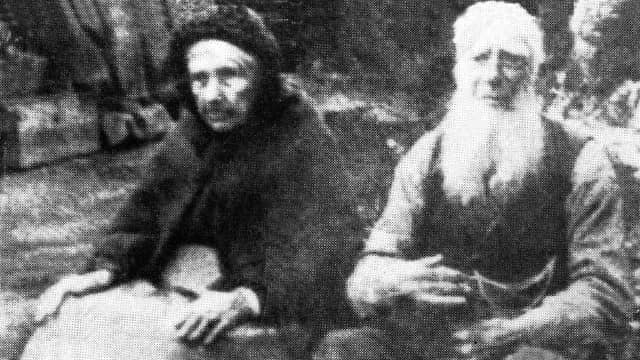

IN October 1929 a fishing boat with a very special cargo bobbed in the choppy waters of Lough Neagh off Ram’s Island. It was a coffin.
IN October 1929 a fishing boat with a very special cargo bobbed in the choppy waters of Lough Neagh off Ram’s Island.
It was a coffin.
Behind the floating hearse was a funereal flotilla of vessels packed with mourners travelling ‘in line astern’.
It was an extraordinary spectacle - but that was perfectly fitting, because the ‘passenger’ at the head of the cortege had certainly lived a life less ordinary.
And Robert Cardwell would not have had it any other way.
He and his wife Jane had lived and worked on the island, one mile out from Sandy Bay near Crumlin, for almost half century guaranteeing themselves a place in the lore of the lough.
It was often a tough and frugal existence, but it was a life they loved, happy to live in splendid isolation on that tiny speck on the horizon.
They were caretakers for Lord O’Neill, who owned the island and used it as a summer retreat.
The late Jim McGarry wrote extensively about their unorthodox offshore life in ‘an ornate thatched cottage with wide overhanging eaves, nestling in thick woodland, mostly composed of stately trees’.
“The O’Neill residence, in the Cardwells’ day and right up until the beginning of the Second World War was a work of art, single storied, set on low sheltered ground close to the raised centre ridge of the island.” wrote Mr McGarry.
“This dwelling was also thatched (and was maintained by a Thatcher from Ballinderry called Albert Devlin) with a very wide overhang.
“The exterior walls were finished in coloured pebbles, with the O’Neill coat of arms set into the front wall, also in multi-coloured pebbles. Much care and artistry had gone into the internal plaster work and cornices.
“The maintenance and daily cleaning of the holiday home, with its sumptuous furnishings, pictures and paintings, murals, and four poster beds with canopies, was the responsibility of Robert and Jane Cardwell, and so they, and eventually their young family, were kept fully occupied between fishing and island maintenance.”
Jane also had a beautiful flower garden on the bank in front of their cottage. They kept a milk cow, milk goats, hens, geese, ducks, and gundogs.
An occasional calf was reared, and this was brought to market using a special cot - a flat bottomed boat - complete with stall and cover.
The Cardwells were practically self-sufficient on the island living on fish, milk, butter, eggs, chicken, tame and wild duck, rabbit and the produce of their vegetable garden and making rugs from the skins of rabbits.
Jane also claimed that she had some help with keeping things clean and tidy - swearing that she was assisted by two ‘wee folk’ who would doff their hats to her.
When the O’Neill family were due to visit the island on holiday, a telegram would arrive with the Cardwells, giving the day and time of arrival.
The boat was sent to shore to ferry the family over on the appointed day, and at the same time the O’Neill house flag would be hoisted up the flagpole on the island, to remain until the family holiday was over.
Since there was no radio or telephone communication in those days, a system of visual signalling was perfected over the years between the Cardwells on the island and those on shore, using various plaque shapes and colours erected on poles.
For example, if there was an emergency and he was unable to get the boat out, Robert would hoist a white sheet on a tree which fishermen would recognise as a call for assistance.
Robert and Jane reared 13 children on Ram’s island too.
In his younger days Robert diligently rowed the youngsters ashore to attend Sandhills School, returning for them that afternoon.
They also loved to entertain visitors, and Robert reveled in showing them the beauty of his island home.
He lived to the grand old age of 88, leaving his wife and daughter, Mary Ann Lyttle.
Jane, the Queen of Ram’s Island, lived on for another three years and was still out feeding the hens on the island until her passing at the age of 103.
Another procession of eight boats joined her as she followed her beloved husband to Glenavy churchyard in April 1932.
Mary Ann and her granddaughter Sadie, lived permanently in the cottage until 1937, the last full-time inhabitants.
It was the end of an era - but not the end of the story.
In the Second World War, the island was used as base for the Allied flying boats, its bays providing shelter.
The location also made it a favourite for romantic trysts for soldiers camped at nearby Langford Lodge.
Indeed to this day trees still bear the names of couples who dropped by in the 1940s.
One particular visit proved to be memorable for all the wrong reasons. A squad of American GIs stumbled upon the grand old summer house and decided to investigate.
Forcing their way into the dusty cellar they found, to their delight, that Lord O’Neill had generously left some of his fine vintage wines. They raised several glasses to their good fortune and ended up roaring drunk.
At some point the lodge caught fire and, sadly, was destroyed.
With the house in ruins and the war over, the trips soon stopped and nature began to reclaim the island, with rats decimating the bird life.
In the late 1990s, a new name entered the story.
The River Bann and Lough Neagh Association leased the island from Lord O’Neill in 2005 for the princely sum of £1 per year.
In time ‘The Island Warrior’ sailed into service, ferrying people from Sandy Bay.
Picnic areas were cleared, camp sites were created and Michael Savage stepped into the fray, wielding his trusty billhook to take down the invasive Himalayan Balsam choking the undergrowth.
The ‘Balsam Bash’ events became legendary, litter picks were also organised, there were organised tours, boat trips and ‘glamping’ became popular.
“The island was completely overgrown back then and the old pier had collapsed,” the local man told the Antrim Guardian at the time.
“We had a big job to do, clearing and creating paths. We had to get rid of the sycamore trees – they’re a weed – before they took over the island, and plant more silver birch, oak, ash and willows, and we wanted to replace the Spanish bluebells that were once planted here inadvertently, with indigenous ones.
“The problem was that after the Second World War, people would come out to the island and take the wild plants, such as snowdrops and azaleas, and sell them at Nutts Corner market and so on.
“We brought in a ratcatcher for 18 months to rid the place of vermin, which had feasted on the eggs laid by birds along the shore.
“She did a great job – we got rid of the foxes that were killing the fowl too. They’d come over from the mainland on the ice when the lough froze over.”
Michael and a dedicated band of volunteers helped turn around the fortunes of the island.
The Savage family have followed the Cardwells into Rams Island legend.
Like the Cardwells, Tracy, Michael, Noreen, Vicky, Brian, and Naomi Savage ‘grew up’ with the island. Indeed in 2006, Michael’s daughter Victoria fulfilled her dream of being married there.
Sadly Michael died in January 2022, but his towering contribution to conservation means that this treasure in the lough will be enjoyed for generations to come.
In July of that year the Springfarm man made his final journey to Ram’s Island.
At Michael’s request, his ashes were spread around the base of the round tower by his family and friends and candles were lit in the evening.
It was also a day to unveil his memorial bench at the place he loved so well.