

The lad from Ladyhill who became the 'Prime Minister of Hyde Park'
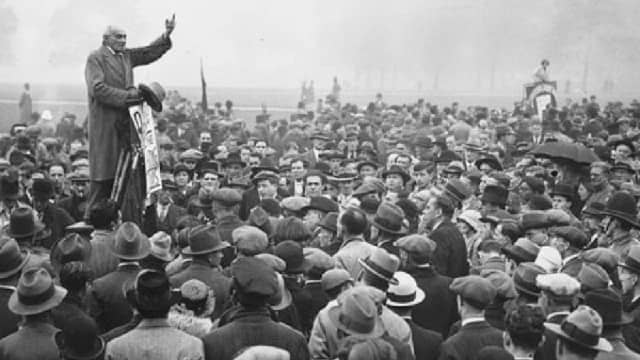

BONAR Thompson, another of Antrim’s alumni of great unsung heroes, lived by his wits. He was born in 1888 to farm labourers Johnny Bambridge and Matilda Bonar, but was brought up by his elderly aunt Eliza Thompson, hence the name.
BONAR Thompson, another of Antrim’s alumni of great unsung heroes, lived by his wits.
He was born in 1888 to farm labourers Johnny Bambridge and Matilda Bonar, but was brought up by his elderly aunt Eliza Thompson, hence the name.
He later remarked of his illegitimacy that he was ‘born out of wedlock and out of pocket’.
He was raised in the wild countryside around Carnearney in the shadow of Tardree and was a pupil at Ladyhill National School - not that he spent much time there.
No, since money was thin on the ground he spent much of his time slogging away in the ‘family business’, working the land.
His life, it seemed, was mapped out in front of him. Bonar would work hard for little reward - and thank the good Lord for it at the local Presbyterian Church each Sunday.
So how come this unpromising local lad ended up counting Winston Churchill as one of his fans and being lauded as the ‘Prime Minister of Hyde Park’?
Well, in short he made excellent use of his natural gifts.
Though schooling had largely passed him by, he was blessed with an agile mind. He was funny too, with a sharp tongue that could cut most down to size.
In other words, Bonar Thompson was a bit of a slabber. The trick would be learning how to make it work for him.
That wit was underlined by the man himself when he recalled Rev Samuel Moffett, who tended his flock around Eskylane until 1917.
“It was easy and natural for young people to laugh at him, good man though he was, for he was eccentric,” he said.
“About 60 years of age, slight and sandy-bearded with a shining bald head, he talked to himself and gesticulated as he skipped across the hills and fields to visit his parishioners.
“I often watched him vaulting the dikes and wire fences, stopped every now and then to peer into a hedge or examine a wild flower. As soon as anyone accosted him he became quite normal and ceased his fidgeting at once.”
But his distinctly odd behaviour put a playful target on his back - such as the chaotic scenes at the ‘annual swarry’.
The event brought together the farm labourers, the wives and their families for lashings of hot tea, thick slabs of cake and a concert.
“And it was usual, after the multitude had eaten to bursting and drunken to saturation, for the more active and undisciplined youths to dip pieces of cake in the tea and fling the sodden mass at the head of some unsuspecting elder, or other pompous person, amid howls of merriment.
“Mr Moffett reproved the larrikins sternly from time to time, but without avail.
“Things became so bad at one of these socials that action had to be taken by the officials of the church to circumvent the activities of the high-spirited merrymakers.
“Mr Moffett had berated them vigorously. ‘It is a sin and a scandal’, he had said, his bald head shining in the lamplight, ‘that many of our brothers in East Africa would be only too grateful’.
“Splosh! A lump of tea-soaked cake had landed full upon the indignant cleric’s sparkling dome.
“His polemic concluded abruptly as, with pieces of wet cake sliding slowly down the sides of his face, he made sadly for the vestry. I felt very sorry for poor Mr Moffett, though I had been throwing cake myself a few moments before...”
As a footnote, the next year the good reverend took decisive action, replacing the cake with a small current bun apiece.
“As many of those present had gone without food for at least half a day in order to do justice to the anticipated feast, a wave of anger swept over the congregation. ‘We want another bun!’ ‘More buns here!’ ‘Do you want us to die of starvation?’ and similar cries resounded through the building.
“Mr Moffett, his face beaming with happiness and bonhomie, moved along the aisles nodding and waving his hand in greeting to his flock.”
But Bonar’s days of tormenting the clergy were drawing to a close. By the time he was 14, he was leaving Ladyhill behind him, as he and his mother upped sticks and moved to Manchester.
Bonar soon landed a job as a ‘greaser’ with the Great Central Railway - but, more importantly, his time in the city ignited a life-long love of reading.
He consumed anything he could lay his hands on in the Manchester Free Public Library. Better still, he retained much of it, committing huge tracts to memory.
Though he adored Shakespeare, his tastes soon extended to politics. He studied Karl Marx (whom he later called a bore) and Peter Kropotkin, the Russian anarchist, and was initially drawn to their radical views.
But for someone so drawn to the plight of the working man, he had very little work in him.
The teenager was attracted to the notion of ‘getting a living without working’ - and then came the Eureka moment.
His introduction to public speaking was at Stevenson Square during a rambling Sunday walk. After experiencing an unfamiliar and heady mix of politics and rhetoric, he resolved to attend the square every Sunday ‘until I had plucked out the heart of the mystery that lay behind the high-sounding phraseology of the orators’.
Said he: “The things I learned gave me a new outlook on life. Several of the regular speakers there fascinated me to a degree which, in the light of later experience, appears absurdly impossible.
“I sat at the feet of men who were the veriest ranters and gasbags. But I have always been susceptible to the sound of words. These men were dealers in words.
“Few of them possessed any real knowledge of anything, but they had the jargon of revolt at their tongues’ ends. As the well-worn phrases fell from their lips I imagined myself to be listening to the most wonderful and original thoughts.
“How could I have known that it was the standardized fustian of half-baked mouthers and half-baked malcontents? It seemed new to me.
“Before long I came to an important decision, and one which was to shape the course of my life. I resolved to become a speaker. To sway masses, to dominate crowds, to hear the applause – here was an easy road to fame.
“More than that, it was a chance to escape from poverty and hard, irksome, badly paid labour. It was the same motive as had driven the labour leaders out of the factory and the mine – the stern resolve to get away from hard manual labour at all costs.”
By 1905, at the grand old age of 17, he was ready to give it a crack, making his maiden speech at a meeting of the unemployed. He was hooked and soon ‘the boy orator’ was advocating revolutionary socialism from public platforms throughout Britain and supplementing his income by passing his hat around for ‘collections’.
He was also involved in socialist agitation, and was imprisoned in Rochester borstal in 1908 for breaking windows.
He was released in March 1909, and decided to move to London, walking the 200-odd miles, rabble rousing as he went.
Bonar was keen to test his mettle at the world famous tub-thumping Mecca on the fringes of Hyde Park. The unsmiling Antrim lad with the big black hat was going to unleash his opinions at Speakers’ Corner.
And he was an immediate hit with the crowds.
That mischievous humour that had served him well at Ladyhill was key. He would treat them mean to keep them keen. Hecklers were elegantly but brutally dispatched.
“There is a great deal of cruelty in all crowds, and much baiting and badgering of the half-witted speakers goes on. Some of this is good-humoured, but some is definitely vicious.
“The religious fanatics are the butts of the more ill-natured among the crowd. Those earnest soul-savers who have found salvation at the expense of sanity do not even seem to mind their mild martyrdom. They live in a state of sustained emotional exaltation and have found that peace which the world cannot give.”
Control was key.
“Keep ‘em guessing, bait your audiences, insult them, taunt them, badger them - but whatever else you are, be witty,” he said.
Another party piece was his ability to quote from the work of any author his audiences named.
No subject, ‘human or divine’, was safe from his wit. As he observed himself, he never listened to one of his own speeches without learning something!
During this period public speaking was often his sole source of income and he also considered it his profession. His trademark hat was used to collect the wages.
However, he also thought himself rather poor at ‘tapping’ people for money and in 1911 he joined forces with a chap called Leo. Leo had an ‘astounding fund of audacity and no scruples’, according to Thompson.
In one memorable episode outside the outer lobby of the House of Commons Thompson encouraged Leo to try his luck with three of the emerging politicians. From the Liberal’s Herbert Asquith he gained a sovereign, the Tory’s Austen Chamberlain a whole pound and the Labour Party’s Ramsay MacDonald nothing but cold steely eyes. Explaining the failure of Leo, Bonar stated that ‘these men talk about poverty and the rights of the poor. That is their contribution to the alleviation of human suffering’.
But war clouds were gathering and in 1916 his call up papers arrived. A conscientious objector he refused to march to war, declaring himself to be a revolutionary socialist of years’ standing and totally opposed to a war he saw as ‘the outcome of the greed and jealousy of the Capitalist Class’.
He was arrested for evading military service and spent the rest of the First World War in a variety of work-camps.
He did not return to London until the 1920s, but it was a golden age for him - a time when he was formally elevated to ‘Prime Minister of Hyde Park’. He was, most agreed, ‘the greatest talker of them all’.
Every Sunday he was there at his regular patch at Marble Arch and as his reputation grew, so did the crowds - often including major political figures of the day. Even Winston Churchill spoke of his admiration.
He was once described by Lord Elton as ‘one of the most original figures in the life of our times’. The Socialist Leader dubbed him ‘the most brilliant intellectual vagabond of the century’.
When he fell ill his absence was noted. WJ Brown MP raised a fund to help him.
Future Labour Party leader Labour politician Michael Foot was a fan too, remembering him as a ‘one man satirist of the universe, this world and the next’.
Soon, word of his fame reached Northern Ireland. Derry-born writer Robert Greacen decided to visit London to see what the fuss was about. He was not disappointed.
‘He cast a cold eye on politicians and propagandists of all stripes, and served up a piping-hot commentary spiced with wit and humour’, he concluded.
‘The Hyde Park Orator is enlivened by a similar combination of declamatory energy, caustic wit and pungent opinion. Thompson’s well-honed rhetorical skills and ‘inborn histrionic talents’ make him a highly self-dramatising autobiographer who adroitly exploits the genre’s affinity for egotism, bombast and display’.
Once seen, never forgotten.
On one occasion an American asked him what were the main industries in Ireland were and, without missing a beat, he replied ‘horse racin’, dog racin’ and immigracin’.
On another occasion he declared that: ‘I am famous. I am the only speaker here who has not been to Russia’.
He even declared, without a hint of irony that; ‘It can be laid down as an axiom that the man or woman who has never heard me speak has failed in life’.
For a young man who shirked his studies in his those far off days in the Antrim hills, he certainly found his own voice. He was invited to speak at Oxford University twice, he was a frequent voice on the radio and a face on television. He published three books and even ran his own journal, ‘The Black Hat’.
But he never made any money. The most he ever received from his collection, he said, was £3. But he got by, and that was enough.
Back in 1944, Beverley Baxter saw that for herself when she dropped by to review Bonar’s stage show at the Gateway Theatre.
‘The audience was not large. It numbered five until the arrival of my companion and myself.
‘Mr Bonar Thompson, as his own financial backer, may have felt some disappointment, but as an artist he gave all he had.
‘Mr Thompson was born in Ireland to very poor parents, but poverty could not rob him of a rich inheritance of wit, melancholy, an artist’s hands and hair, ironic humour, a love of language, and a genius for making nothing pay.
‘He crossed England where he decided that what he really wanted in the world was to talk. Spouters’ corner at Hyde Park fascinated him. There on platforms and soap boxes men would talk for hours while people listened.
‘What better could one hope for this side of Paradise?”
He died in January 1963 after a long illness. Always keen to have the last word, he even penned his own epitaph.
It read: ‘Here lies Bonar Thompson, born 1888, died 19__. The collection was not enough’.
You can’t argue with that - though he would probably give it a go.
In 1991, Antrim Historical Society decided to celebrate ‘one of the most talented yet - in a way - laziest characters ever to draw breath in Antrim’ - and Michael Foot flew over to honour the ‘hero’ of Hyde Park.
Though largely forgotten today, the former farm lad lived the life he pleased by ploughing his own furrow.
And I, for one, am glad he did.