

The local family who built their home on top of a mass grave!
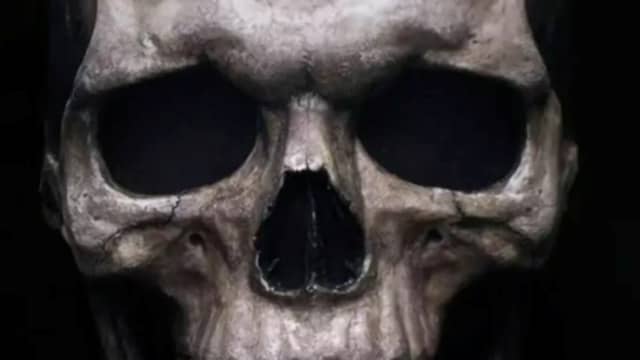

THERE are few sights in nature as peculiarly unsettling as a human skull. It’s an odd observation - after all, we all have one - but there’s something deeply unnerving about that rictus grin, those baleful empty sockets.
THERE are few sights in nature as peculiarly unsettling as a human skull.
It’s an odd observation - after all, we all have one - but there’s something deeply unnerving about that rictus grin, those baleful empty sockets.
Thank goodness, then, that we so seldom see one on our travels.
But they do crop up from time to time, creepy reminders of our own mortality...
In the unlikely event that you actually went looking for one, a graveyard is as good a place to start as any - but be careful what you wish for.
Back in January 1914, one local cemetery offered quite a sight to behold for thrill seekers deadly serious about spotting the seriously dead.
The precise location was not named in contemporary reports, for reasons that will become apparent, but Antrim Rural District Council were briefed on its ‘revolting condition’.
‘Sanitary officers’ responded to ‘gruesome reports’ of frankly shocking practices at the burial ground.
They revealed that interments were taking place a few inches from the surface, and that in one particular case a coffin and corpse were cut in two during the digging of a new grave.
To add insult to injury, the remains were then unceremoniously ‘thrown in a heap on the top of the ground’.
And it got worse.
For in the meantime dogs had found their way into the cemetery and one of the inspectors had to chase one of the four legged intruders and remove a piece of human flesh from its maw.
There was also disturbing evidence that foraging animals had already ‘carried away and hidden human remains’.
A clergyman officiating at another funeral reported that be noticed body parts scattered about where be stood.
Councillor Allen said the situation had become ‘truly horrible’. Few would disagree.
But these things happen - even at prestigious addresses.
In April 1964 Joseph Leckey from Belfast decided to treat himself to a day trip to enjoy ‘places of great beauty in and around Templepatrick’. He got more than he bargained for.
“One of the historical places we visited was Castle Upton graveyard,” said Joseph.
“In the corner there is lying an almost complete skeleton. This is the remains of someone who was, presumably, given Christian burial there at some time in the past.
“Could not these bones, and the fragments of coffin with them, be decently re-interred?
“Apart from this I found much beauty and great hospitality.”
Yes, lovely people apart from those blasted bones!
In August of that very same year, an ‘Antrim farming family’ - their names withheld to keep the ghoulish at bay - revealed that ‘dem bones’ had become a fact of life.
And they hadn’t ‘cheated’ by visiting a cemetery to find them.
‘They find skeletons the way other people find half crowns, fountain pens and umbrellas and have become quite blasé about it’, penned a reporter at the scene.
‘A woman of the family, who unearthed the latest two the other day, expressed no surprise’.
‘“We have come across them before,” she said.
‘Farmers are quite rightly more concerned with digging up things that help to put flesh on contemporary bones rather than with the dry bones of some 2,000 years ago, and it is a matter for archaeologists to study how the head bone was connected to the neck bone in those halcyon days.
‘Unless the Government put a subsidy on skeletons they are unlikely to become a staple crop’.
You can imagine the scribe chuckling to himself as he clattered on the keys of his trusty typewriter 60-years-ago!
In 2003, the construction of Antrim’s new branch of Tesco was well underway on the site of what was formerly the Massereene District Hospital.
Whilst excavating the plot to pave the way for the supermarket’s car park, however, workmen were chilled to uncover grim mementos evocative of the locale’s chilling history.
Skeletal human remains, believed to have lain undisturbed since the mid-19th century, were liberally scattered throughout the planned building site.
Development continued at a sporadic pace as, time and time again, work was halted and the police summoned to verify and investigate the latest findings.
Given the proximity to the town’s Victorian era workhouse, local historians came to a logical conclusion - that the builders had unintentionally unearthed a typhoid pit.
Spare a thought for those poor souls whose final resting place was anything but next time you nip in for the weekly shop.
Mass grave
The World Cup may have dominated the headlines back in July 1966, but much closer to home an altogether more curious story was hitting the front pages.
Archaeologists and forensic science experts were converging on Rathmore, near Dunadry, following reports of bones being unearthed.
We are not talking about one or two here. In total there were more than 30 skeletons on the quarter acre site.
Brian McNally, from Randalstown, was the man who raised the alarm.
“I was shocked when I saw a human skull peering out of the ground,” he said.
“With further excavating I found a mass of skeletons lying in disorder.
“Some were in good shape, teeth and skull well preserved. In other places there was just a mass of bones.”
Some of the skeletons were unearthed about six inches below the surface. Others were buried to a depth of two feet.
It was surely a perplexing time for the family who were building a new house on the site? Not a bit of it.
Indeed Robert French, who ironically was a meat inspector by trade, and his wife Anne were very keen to plough on with the project.
He revealed that the excavations were complete and McCombe Bros from Antrim were waiting in the wings to start laying the foundations.
“At least we should have a good garden at our new home,” said Mr French.
“They say old bones are good fertiliser.”
So who were these squatters and how had they got there? Opinions, it seems, were conflicting.
Local folklore expert William John McGrath reckoned the site was possibly part of a graveyard in use from the 10th century.
There was also a chance, he added, that they may have stumbled over a mass grave created after the Battle of Dunadry in 1649.
Other suggested the skeletons could date back to the Battle of Antrim in 1798.
For their part, Templepatrick police showed no interest in digging into this coldest of cold cases.
A spokesman confirmed that the matter had been referred to ‘experts from the Ancient Monuments Branch of the Ministry of Finance’.
Maybe the French family had the right idea. The remains may have been there long before them, but they meant no harm - and they didn’t complain when it was time to say au revoir for pastures new.
But anyone who has seen ‘Poltergeist’, which focuses on the consequences of waking the sleeping dead to build swish new houses, might have some reservations.
Me? I would have run a mile.