

The Randalstown surgeon who laid down his life in WW2 to save others
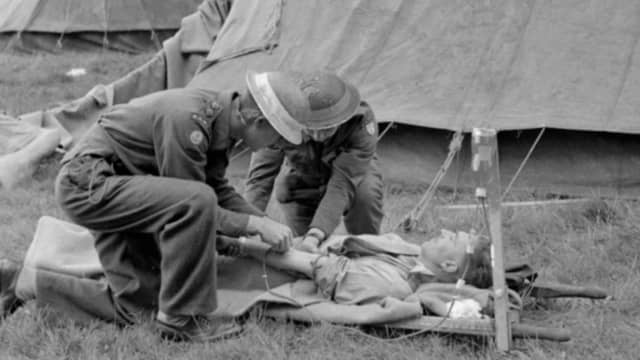

MUCH has been written about the extraordinary heroism of troops plucked from their ordinary lives to fight in foreign fields. But to date much less has been written about the courageous people who put their lives on the line to save others - the surgeons, the doctors, the nurses who raced against time to mend bodies broken on the battlefield.
MUCH has been written about the extraordinary heroism of troops plucked from their ordinary lives to fight in foreign fields.
But to date much less has been written about the courageous people who put their lives on the line to save others - the surgeons, the doctors, the nurses who raced against time to mend bodies broken on the battlefield.
A new book, ‘Irish Doctors in the Second World War’, tells the story of these altruistic unsung heroes.
The fully illustrated hardback features a Roll of Honour recording Irish doctors who served, were decorated, and lost their lives - including several local medics.
People like Arthur Majury, who lived at The Manse on the Greystone Road, who rose to the rank of Wing Commander with the RAFVR.
It also includes harrowing correspondence from Irish doctors detailing the horrors of the Atomic Bomb and the liberation of Nazi concentration camps
Inevitably, there are heart-breaking stories of loss too.
From a young age Hugh Marks from Randalstown knew he wanted to pursue a career in medicine - and he was prepared to put the work in.
He studied hard at Portora Royal School in Enniskillen, following in the academic footsteps of Oscar Wilde and Samuel Beckett.
A very capable student, he earned a place at Queen’s University, where he eventually qualified.
The local man was appointed senior house surgeon at Kidderminster District Hospital, and there are several contemporary news reports of him giving expert counsel at inquests and court proceedings - right up to January 1941.
At around that time he decided to offer his medical skills to the war effort, volunteering to the Royal Naval Volunteer Reserve.
The call-up finally came in March that year. Surgeon Lieutenant Hugh Marks had been posted to a ship in the east and sailed from England as a passenger.
But the convoy came under attack on March 25 and the ship he was travelling in was sunk.
The Randalstown man survived - but barely.
He clambered onto a raft, but died two days later of exposure.
Initially he was listed as missing, but in May his mother - who had already lost her husband Hugh - received the notification that she had dreaded.
Her only son had been officially ‘killed in action’. His war was over before it really begun.
The archives reveal that his death ‘cast a gloom on the town and district’.
‘He was a young man much beloved by all who experienced his kind and genial acquaintance’.
‘Irish Doctors in the Second World War’ by Patrick J. Casey, Kevin T. Cullen and Joe P. Duignan is published by Merrion Press and is priced £26.99.