

The scandalous case of the Antrim cleric and the headmaster’s daughter
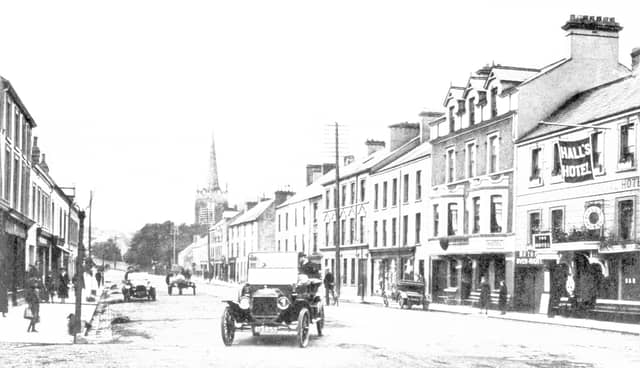

How a sleazy story of seduction rocked Antrim society to its core a century ago
BACK in August 1921 there was only one topic on the lips of the people of Antrim.
As a story it had it all - a heady cocktail of sex and sleaze involving several prominent pillars of the community.
Over three extraordinary days at Belfast Assizes reputations were literally laid bare as a local headmaster battled to restore his daughter’s good name by hauling a popular young cleric over the coals.
Joseph Needham, who had taught at Massereene National School for 38 years, brought the action against church curate Frederick J Cinnamon, accusing him of ‘betraying’ his daughter Florence.
And it created a sensation.
James Andrews KC was first on his feet in front of a packed courtroom to set out the shocking case for the prosecution.
It was, he said, ‘one of the most important and one of the most serious cases’ to come before a jury in recent memory.
Florence Needham had been taught by her father at Massereene but after school she had been apprenticed to a milliner in Antrim.
But as war clouds gathered over Europe, she heeded her country’s call and joined the Women’s Auxiliary Army Corps. She was demobbed in April 1919 and returned home to Antrim.
The following April, a young cleric arrived in town to help Rev Canon Collis with his flock in Antrim Parish.
And within days, the prosecution claimed, he took particular interest in one of his parishioners...
Florence was visiting her uncle in his jewellery shop, but when she left the young curate strolled in and began asking questions about her.
A few days Mr Needham met the new arrivial at a Boys’ Brigade meeting and afterwards they returned to the head master’s house. And Florence was there.
There were two or three ‘chance meetings’ in the days that followed.
Mr Andrews asserted that it was ‘perfectly apparent’ that Mr Cinnamon was ‘anxious to get to the house’.
And the parents did not seem to mind. After all, he was a gentleman and he had ‘certainly had something in the nature of affection’ for their 24-year-old daughter.
The court was told that things moved up a gear in May. The curiously attentive cleric had dropped by yet again and after chatting with mother and daughter, he took Florence into the parlour. It was ‘perfectly innocent’, initially at least.
Mr Cinnamon spied a manicure set and suggested that his host put it to good use on his nails.
“Then conduct took place which certainly struck the girl as surprising,” said the barrister.
Without warning, he caught the girl by the ankle. She objected and he responded by suggesting that every girl was ‘playing the same game’.
Nevertheless, he released his grip and left a short time later.
Two days later, Florence recalled she was gazing out an upstairs window when she saw the defendant striding up the street. He spotted her too and he ‘kissed his hand to her’.
It was becoming clear, the prosecution maintained, that he was interested in more than her mortal soul.
He called at the house and asked Florence to join him for a walk to Lough Neagh, and she agreed. The local woman later revealed that during that stroll he put his arm around her and they shared their first kiss.
Things got even more serious in the first week of June when the first ‘actual impropriety’ allegedly took place.
He again took Florence into the parlour and after chatting he beckoned her to join him on the sofa.
“And there the poor girl, who up to the time she met this man was as innocent as any girl who walked this earth, yielded to his persuasion and fell,” said Mr Andrews.
The shocked jury were told that this was to be the first of several dalliances.
One took place, they claimed, on the evening of Sunday July 4 after Florence and her mother returned from evening service - which Mr Cinnamon had delivered.
All the while, her parents were blissfully unaware of the ‘unfortunate tragedy which was being enacted in their own home’.
That all changed, however, on September 29 when Florence’s mother discovered them ‘in an exceedingly compromising position’ in the parlour.
Then all hell broke loose. Florence made her charge against the defendant in the presence of Rev Collis, who asked for his resignation. Canon Cinnamon obliged and left to become a teacher in Kidderminster - a career in the church no longer an option.
The prosecution then set about putting flesh to their version of events by calling their first witness - the girl at the centre of the story.
She told the court that it was during that fateful walk along the golf links at Massereene that Fred - as he asked her to address him - first conceded that he was ‘glad to have met her’.
And the feeling was mutual. On one occasion in June he asked her if she would like him to be her husband, and she said she would.
“I was very fond of him,” she said.
Florence was away working in Ballykinler for several days in July, but on her return on the 17th he paid another visit - and raised eyebrows - when he pulled her onto his knee in the kitchen in full view of her mother.
Later that day ‘impropriety again took place’ - once again in the parlour.
She then turned her attention to the day they were discovered. Her mother had left the house to bring her husband’s lunch to the school, when Fred once again began ‘carrying on’.
Though she knew her mother would not be long, they were soon back on the sofa and in a state of undress when the door flew open.
Mr Cinnamon promptly left and Mrs Needham spoke to her daughter ‘very crossly’.
Upset, Florence got dressed and went to speak with a female friend when she encountered the defendant on the street.
“This is an awful thing that has happened,” she said.
He said he would return to the house and ‘make it all right’.
She then recalled the dramatic moment when Frederick, Canon Collis and her parents came to her bedroom to demand her version of what had happened.
The defendant asked her if he had ‘done her any harm’ in September, and she said it was actually in June.
But there was more. Florence had discovered that she was pregnant and she ‘broke down almost completely’ when she confirmed that the accused was the father. Sadly, the child subsequently died.
Under cross examination, she was asked if Mr Cinnamon had ever pledged to become her husband.
“When he said he would see me all right I thought he would marry me through time,” she replied.
“What in the name of heaven induced you to give way to a strange young man on the third occasion on which you were along with him?” asked the defence.
“I trusted him and had a love for him - and he told me it would be all right.”
Florence admitted she did not know he was courting another young lady in Antrim at the time. It later transpired this was the daughter of Antrim Town Clerk Archibald McKay. The couple had began seeing each other in April 1920 and became engaged in October.
Before leaving the dock, she also denied any suggestion that he had been ‘walking out’ with men during her time at Ballykinler, or writing affectionate letters on her return to Antrim.
Next to give evidence was Susan Needham, who said that early impressions were favourable.
“He always appeared to be a gentleman before us, and very plausible in every way,” she said.
She also cast her mind back to September 29 - and that revealing return home.
Mrs Needham said she initially saw the pair on the sofa reflected on a mirror opposite before she made her presence felt.
The young cleric, she said, made a curious attempt to explain her daughter’s state of undress.
“You don’t know how many stones Flo can bear on her knees,” he said.
“I have done your daughter no harm,” he added.
When he returned after meeting Florence on the street, he said she was in a ‘terrible state’. Mrs Needham also got a sense that he was preparing to ‘bluff the thing out’.
Her husband then took the stand, recalling one evening when he noticed that their guest had his hand on his daughter’s knee.
He also rejected the notion that he was bringing the action to ‘blackmail’ Mr Cinnamon.
“I want no money off him at all. It is absolutely for the sake of my daughter,” he said.
Then it was the turn of Rev Canon Collis to share his role in the story - though the court heard that he had attempted to resist his call to the dock.
By then he had served 31 years in Antrim and he recalled the moment he was drawn into the ‘unfortunate episode’ when Mrs Needham paid him a visit ‘in great distress’ on October 29.
He spoke to the defendant two days later, after receiving guidance from the bishop.
“He bent down in distress and said he would ‘go away somewhere else and begin afresh’. This was repeating really what I had advised him to do,” he said.
The following day there appeared to be a change of mind. He would not go as this would be construed as an admission of guilt. No, he wanted to face his accuser.
Under cross examination, he was asked if it was fair to speak to the bishop without first investigating the claims.
“It was not a rumour; it was an accusation - and a very serious accusation,” he said.
“I suggest you have treated this young curate disgracefully and unfairly,” said Serjeant Hanna for the defence.
“Your remarks are absurd,” he replied.
He was equally scathing about Mr Cinnamon. He felt he had ‘either lost his senses’ or he ‘was a fool’.
And then a further twist. A young, well dressed man was called from the public gallery. He had been following the case in the press and felt compelled to attend in person.
He said he had been intimate with Florence in the Kensington Hotel in Belfast in early 1920. She insisted she had never seen him before.
Now it was the turn of the defence, and Serjeant Hanna said much was at stake. It was a matter ‘practically of life and death’ for his client - a man of ‘absolutely blameless character’.
The case, he said, had been prejudiced by Canon Collis when he decided to report to the bishop before talking with the curate.
The Needham case, he added, did not stand up to much scrutiny.
“Practically the first time she met him she claimed to have manicured his nails and he was said to have taken liberties with her ankle.”
He added that she was not a ‘country girl’. She had been in the WAAAC and had spent time in Belfast and Ballykinler. In short, she was a ‘bit fly’ and not the innocent prude she was portrayed as.
Referring to Ballykinler, the defence said ‘it was quite within the range of possibility and probability that a girl who might have a tendency to flightiness and looseness of character might have met with a mishap there’.
Charles Donnelly had worked in the kitchens at Ballykinler in July 1920 and had known Miss Needham to ‘walk with men’. Indeed, she had written four letters to him, though he no longer had them.
Finally, Frederick Cinnamon was called. He was cool and collected in the dock, answering all questions without hesitation, He gave a ‘most emphatic and unequivocal denial to all the charges’. He had never acted immodestly towards the girl; he had never kissed her; and no act of impropriety had ever taken place.
“I never was alone with her in my life.”
Nor was he at the Needham house on July 4. That day he had conducted a service at Antrim Asylum in the morning, then another for an Orange Lodge at Muckamore and then the evening service in Antrim. After that he went to calm a local girl suffering from ‘religious mania’, staying with her well into the night.
He had been told that Mrs Needham had developed a ‘grudge’ against him.
He said that Canon Collis had agreed that the story was ‘full of holes’, so why then did he appear to side with them? He suggested that it was ‘jealousy’.
“He saw I was popular in the parish and he was not. He had known the Needhams longer than me, and I suppose he preferred to take their story before mine.”
Summing up, Mr Justice Moore said the jury faced a difficult task. He did wonder aloud, however, why the action was brought in the first place.
“The father said he did not want money at all, but wanted to clear his daughter’s character. Now, how did an action of that kind clear a girl’s character? She was brought into court and made a public display of; and they were told that she succumbed to this man without even a promise of marriage. How could that clear her character?
“No, the father was bringing this action from perfectly fair, but still vindictive motives to punish the alleged seducer of his daughter.”
The jury took just 10 minutes to decide. The verdict was not guilty - and Rev Cinnamon was the recipient of hearty congratulations from the crowd.
It was undoubtedly a long journey home for the Needham family...