

The talking dead: how a seance culminated in a society scandal
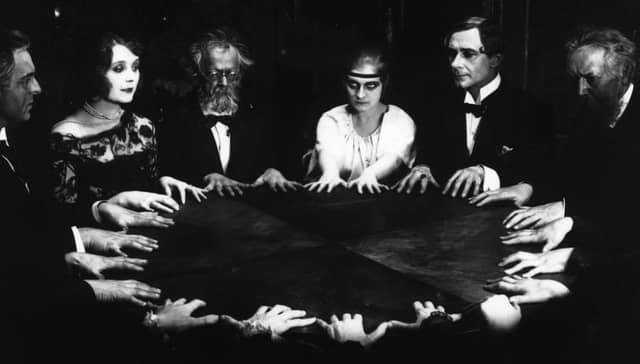

SO where do you stand on the walking dead?
Well, back in 1994 the good people of Antrim were being asked to pick a side.
You see Pentecostal pastor Victor Onuigbo was in town - and he claimed that he knew a thing or two about reanimated flesh.
During his service in Antrim that June, he maintained that he had been brought back to life after he met Christ, who said he still had work to do in the mortal realm.
And since then he had been busying himself by raising the dead. Fourteen of them, to be precise.
Free Presbyterian Minister David McIlveen wasn’t buying it - and he set the Nigerian ‘archbishop’ a simple challenge.
“I would ask him to accompany me to some cemeteries around Northern Ireland. I would be very interested to see what would happen,” he said.
He added that the Bible made it clear that there was no need for ministry involving the raising of the deceased ‘in today’s world’.
“Nowadays there is no need whatsoever for any extra-Biblical demonstrations of God’s power.”
Mr Onuigbo disagreed, suggesting the Minister ‘must have been reading from a different Bible’.
He directed him to Luke, chapter nine - ‘Christ sendeth his apostles to work miracles, and to preach’.
“I don’t look at it as something fantastic. It is the will of God to prove He is able to do all things. People need to feel God and that is what is happening,” he said.
Local businessman Crawford Taylor, who organised the Antrim service, knew who he was backing - and scoffed at the Rev’s graveyard challenge.
“Some of the people Mr Onuigbo rose from the dead were dead for several minutes, some for several hours. They were not buried in the ground,” he said.
For those who believe, no proof is necessary. For those who don’t, no proof is possible.
The jury may be out on the walking dead, but what about the talking dead?
Spiritualism, communing with the dead, may be considered bunkum by many today, but for a time in the Victorian age and well into the 20th century it was all the rage in fashionable society. Even Arthur Conan Doyle, of Sherlock Holmes fame, was a staunch believer.
This is the story of a simple seance, a gravely wronged woman, a local nobleman and an extraordinary newspaper report which killed a publication stone dead.
Contemporary reports are shy of naming the man who got the ball rolling, describing him simply as ‘a captain in the army’, but he had a hunch that his wife - Mrs Sophia Fanny Gabrielle Wallett Colley - was ‘playing away’.
His bid to find concrete evidence was deadly serious, so he sought counsel from the seriously dead.
He was interested in spiritualism, so he decided to take part in a seance to get to the ‘truth’.
The invisible jury confirmed Mrs Colley was guilty as charged and the spurned husband instructed his lawyers.
It became known as the ‘spiritualistic divorce case’ - and it created a sensation.
He alleged that his wife had ‘misconducted herself’ with the Honourable Eric Upton, heir to the title of Lord Templetown and the family’s rather grand castle in Templepatrick.
The case was heard in July 1912 and the ‘facts’ were quickly exposed as a tissue of lies and Mrs Colley ‘won all round’. She obtained an order for the restitution of conjugal rights - and turned her attention to a scandalous report about the affair which appeared in ‘Modern Society’.
The paper suggested that ‘the fun began’ in India...
‘It was when we were all up at Jubbulpore that Eric met Mrs ‘Mickey’ Colley, memsahib to a stay-at-home captain of RFA, whose sporting instincts were chiefly in the realm of spirit-rappings and seances’, began the colourful account.
‘Mickey, however, was Irish and as Eric Upton was full of County Antrim, while she was equally full of Clonmel, he made a special appeal to ‘Mickey’ Colley and very soon they were playing ‘Snookey Ookums’ almost regardless of the consequences.
‘Mickey’s husband was furious, and gave her a good talking to. ‘Mickey’ had heard it all before, so she did not care much; and as Indian bungalows are not quite secluded enough for British lovers used to the certainty of four stout brick walls, ‘Mickey’ came home and went to live at Fleet.
‘The captain had his battery nearby and having got his wife away from all her old ‘flames’ he settled down to forget everything and live like turtle doves. Having to shift his battery to Okehampton...he left the reformed flirt he called ‘wife’ to look after the house at Fleet’.
With Eric still in India, the ‘Modern Society’ scribe said the dubious story should have ended there. But, of course, it did not.
‘When the captain returned to Fleet in 1908 he found the atmosphere electric. Someone had been there!
‘There was a terrible scene, and the truth was at last dragged from ‘Mickey’. It was Eric Upton. The future fifth Lord Templeton had given in to his love for ‘Mickey’ Colley, and followed her across the seas.
‘Found out at last there was about one alternative. Eric had got to marry ‘Mickey’. It now only remained for the captain to divorce his popsey-wopsey and make her a good woman as the Hon Mrs Eric Upton.
‘His family were of course furious with Eric. His mother nightly sobbed herself to sleep’.
But Eric was ‘saved by an almost miraculous interposition’.
It was claimed that captain Colley was called away to a Territorial command in Yorkshire, and his wife went for three months to the Isle of White.
It was the balmy summer of 1909 and the sands ‘invited love’, so when she caught the eye of another gent - an ‘artful Pierrot’ - he did not need asking twice.
‘Soon ‘Mickey’ and her pierrot were bathing together every day and making the sands hot with smothered kisses. For hours they would sit hand in hand in ‘Mickey’s’ parlour at Shanklin, while the neighbours peeped through the blinds and noted the wriggles of the amorous pair’.
At which point Captain Colley returned to the story!
The paper claimed that he had found ‘a bundle of Eric Upton’s yummiest letters’ and popped the whole thing into the hands of his lawyers. And now there was another man.
‘The Templetown escutcheon was saved. The poor inoffensive but amorous pierrot of Shanklin had lifted the onus from the shoulders of the heir of Castle Upton and taken it all upon himself.
‘So Eric Upton was able to leave ‘Mickey’ Colley on the mat and yet do it like a gentleman. He is still a bachelor for many a lark yet’.
You couldn’t make it up, you might say - but of course they had.
This was a hatchet job on a monumental scale.
Indeed Mr Marshall Hall KC, acting for Mrs Colley, shook his head in disbelief.
“Modern Society and the printers are the defendants to other proceedings,” he said, “and Mr Justice Darling said that it was impossible to find a page on which there was not a libel on someone.”
To drive the final nail in the coffin, Mrs Colley was called to give evidence.
She said that she had been completely vindicated during the divorce proceedings and was now in receipt of a small allowance from her husband.
The article in question, she said, had caused her ‘great pain’ - and there was ‘not the slightest truth’ in the allegations.
Replying to Douglas Hogg, who appeared for the printers of the publication, she said she did not know if the report had initially attracted a ‘great deal of attention’ because ‘nice people’ did not read such things.
She added, however, that it was digested by ‘nice people’s servants’ - and the lies soon spread.
Asked if eventually became ‘widely known’, she replied that ‘everybody has heard of it wherever I go’.
And was there any truth in the ‘terrible allegations’?
“It is absolutely untrue,” she said.
Mr Hogg stressed that an apology had eventually been printed by Modern Society.
He agreed that they had been guilty of a ‘serious libel’ but assured the jury that his clients took every care to prevent anything of that nature appearing in print.
Mr Hogg added that the article had appeared while the editor, Frank Harris, had been ill and on leave. ‘Two or three’ issues had hit the presses during his absence, and they contained ‘most objectionable libels’.
He added that JG Hammond and Co, the printers, had ceased to publish Modern Society.
Mr Justice Lush was scathing in his summing up.
“It is a scurrilous and, I cannot help thinking, an infamous publication,” he boomed.
“We are all justly proud of the way in which journalism is conducted in this country and we recognise the high tone that characterises the press and the very high standard.
“Unfortunately, now and again one comes across a very different state of things.
“It is amazing that any journal could stoop to publish such as article.”
The jury agreed and found in favour of Mrs Colley, awarding her £600 damages. That’s almost £90,000 in today’s money.
The Judge added that they should also pay all the costs.
The ruling, of course, also vindicated Eric Upton - but sadly his story did not end happily.
Captain Upton was killed in May 1915 leading men of the King’s Royal Rifle Corps into action. He was just 30.
His Battalion was mobilised and landed at Le Havre on 13 August 1914.
They fought in the Battle of Mons (21-23 August 1914), the subsequent retreat, the Battle of the Marne (5-12 September 1914) and the Battle of the Aisne (13-28 September 1914).
They were then moved north and fought in the First Battle of Ypres (19 October–30 November 1914).
He was wounded in action during the Battle of Gheluvelt and was evacuated to hospital but on recovery he rejoined the Battalion near Neuve Chapelle, France.
More battles followed, but Captain Upton was killed in action close to Rue de Bois.
A hero, he was twice mentioned in despatches.
He is buried in Rue-des-Berceaux Military Cemetery, at Richebourg-l'Avoue in France.
A fortnight after he was laid to rest a large congregation gathered in Templepatrick for a Memorial Service in his honour.
He was well known to local people and was ‘greatly respected’ by them - both for his ‘manly qualities and bearing’, and his long associations with the parish.
His standing was underlined by the number of people in attendance, including Lieutenant General Sir George Richardson, Lady O’Neill, General Sir William and Lady Adair.
The service was conducted by Rev CF Newell, vicar of the parish, who described him as a ‘very fine fellow who had given his life for King and country’.
They all remembered him as ‘a young lad at Castle Upton’ who was ‘good-natured and pleasant with a kind word for everybody’.
All knew him, he said, and ‘everybody liked him’.
“He fell facing the foe. His friend and commanding officer wrote of him ‘As he lay on the ground there was a smile on his face’.
“What more glorious, unselfish and noble death could a man die? What is finer for a man to lay down his life for the great cause and principle for which his King and country stood?”
Lady Templetown also saluted her son’s selfless sacrifice.
“We give him freely and without a grudge, though the loss well nigh breaks our heart,” she said.
Quite a contrast to the cad portrayed by Modern Society. Shame on them.