

The terrified soldier who stole a watch to buy himself some time

TIME has got a habit of wiping away much evidence of what went before. Take a stroll through any old churchyard and you will inevitably see rows of blank headstones, the names quietly smoothed away by the passage of the years.
TIME has got a habit of wiping away much evidence of what went before.
Take a stroll through any old churchyard and you will inevitably see rows of blank headstones, the names quietly smoothed away by the passage of the years.
Grand buildings, like the huge monastic settlement at Muckamore, can disappear too. Even entire towns can be swept away as if they had never existed.
The rolling green fields of the Shane’s Castle estate look for all the world as if they have remained unchanged for centuries - but don’t be deceived.
Look again from the air and you might make out tell-tale signs of jagged lines in the landscape that look like trenches. There are holes that weirdly resemble the scars inflicted by shells on the western front.
But how could these curious echoes of a Flanders field be found in a quiet corner of Randalstown? The answer may surprise some.
Because it was there by design.
The outbreak of the Great War saw millions of men enlist to fight for King and country - but the problem was how to shape these civilians into an effective fighting force.
The problem was tackled locally. With newly created Brigades and Divisions recruiting from their own towns and Counties, it made sense to address the issue of training at this level, but hundreds of vast new camps would be required.
By 1914 four such camps had been constructed in Ulster, at Antrim, Ballykinlar, Finner and Clandeboye.
Randalstown would be number five, sited on a 50 acre site offered by Lord O’Neill.
The new camp would be capable of housing more than 5,000 British and Irish soldiers in preparation for the trenches of France.
As a location it was ideal. Randalstown was a greenfield site offering open land for the building of barrack blocks and siting of tents, a local fresh water supply, access to rail and road links, as well as a large estate for training.
But time was of the essence. Construction commenced in October 1914, and the camp was completed in just two months.
On December 18 troops from 3 Brigade Ulster Division arrived from Finner Camp in County Donegal - after a march of 90 miles.
The Royal Inniskilling Fusiliers joined them in January 1915 - as did the Royal Irish Rifles 14th (Service) Battalion (Young Citizens).
The camp was primarily an Infantry Camp split into four named camps - Mount Camp No. 1, Dunmore Camp No. 2, Ridge Camp No. 3 and Hollow Camp No. 4. Combined. The planned capacity of the four camps was 128 Officers, 4,524 ‘other ranks’, and 220 horses.
As well as the trenches, a firing range enabled troops to develop their basic rifle craft before moving on to a set of three ranges, providing a total of 56 lanes, located to the south of the main camp enabled soldiers to train in full-bore marksmanship.
In time, the troops moved out and the camp was deserted. But not for long.
Soon soldiers, injured and maimed, were flooding back to England.
By early 1916 it was decided that a number of Command Depots would be required for the training of convalescing soldiers who would be typically too well for a normal convalescent camp, but wouldn’t have been fit enough to return to their units. Primarily they were designed to ease the burden on beds in UK hospitals. And Randalstown fitted the bill.
It had the capacity to deal with 40 injured officers and some 3,800 troops.
It is understood that one of the camps was still used for infantry training, while the other three dealt with the wounded.
It remained a convalescent hospital until December 1919 - long after the end of the war.
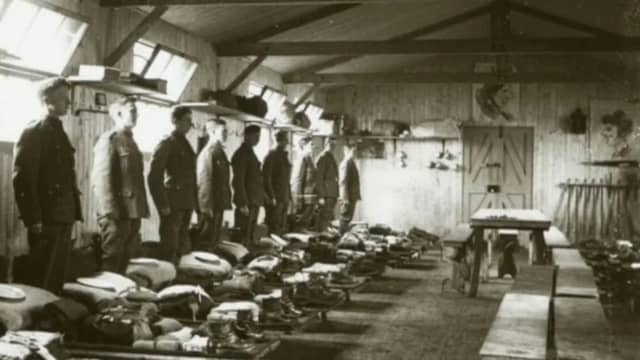
Though that was just a century ago, practically no evidence of the ‘invasion’ remains today. Even photographs are in short supply.
So what was it actually like in the camp? Well, it seems that it depends who you ask.
One visiting scribe in the summer of 1915 paints a vivid - and unashamedly patriotic - version of a day in the life.
It was, he said, like a ‘miniature Aldershot’.
‘Truly that was the impression primarily created by the sight of hundreds of bronze-faced, clean-limbed fellows who were seen to be moving about it’, he wrote.
The huts, though rudimentary, were neat and tidy and some were guarded by men with rifle and bayonet. Well, there was a war on.
‘The greatest orderliness and strict cleanliness prevailed everywhere - and above all shone the golden sun’, he continued.
‘It was a perfect day. Glorious and undimmed by cloud or vapour, the sun bathed everything in its golden glow, and its very effulgence blotted out for the time at least the fact that this was but preparation for the grim, stern realities of the trenches.
‘It was only when one had penetrated further into the camp that the realisation came that this was no mere holiday ground, but a very important factor in the national life.
‘This Randalstown camp perfected under the necessities of training for the terrible world war is a triumph of organisation,
‘Whatever may have been its defects heretofore, it is now a revelation of what can be effected by skill, experience and preparation’.
And his appreciation of the fighting men knows no bounds.
‘In the park itself alongside the Shane’s Castle demesne, there are many oak trees - fit emblem of the sturdy manhood now being brought to its highest pitch of perfection for the contest of the immediate future.
‘And what fine fellow these are! Bronzed brown by the sun, made fit by constant exercise and disciplined by experienced officers, they are a splendid lot of men.
‘Note their easy swing, the free stride, the rhythmic movement of the body. It would be hard to find such a magnificent set of men as those congregated in the Randalstown encampment’.
And he found the mood was also upbeat.
‘As the interested visitor moves from point to point, he is absorbed by the charm of the place and the life he sees. Passing through the lines he can’t fail to feel the sense of joviality and buoyancy, of cheery goodwill that emanates from every side.
‘The ‘boys in khaki’ welcome their friends with hearty good wishes; they take and shake their hands with cordial and warm grips; they laugh whole-heartedly like up grown schools boys long prisoned but now let free.
‘You feel the magnetism of their presence even though you do not recognise a friend’.
It sounds as if he would have been happy to stay, but the hour was growing late and he had to leave.
‘Officers’ mess, non-com, canteen, the common or garden but always loveable private soldiers’ quarters - I had the pleasure and privilege of going through them all, and I recollect them with mingled feelings of pleasure and regret.
‘Of a delightful cup of team underneath a spreading oak, of a happy half hour with well-remembered non-commissioned officers - splendidly described as the backbone of the British Army - of the kind-hearted and jovial ‘major’, a proud father of twins; of the pocket Hercules, named on the spot ‘Hackensmidt’, a name that stick to him until the trumpet call; of kindly lads whom it was a pleasure to see once again’.
One can only guess how many of them breathed their last on the battlefield.
The reporter was clearly on a mission of his own that day in Randalstown - to assuage the fears of loved ones at home.
Their men were safe and well far from home. Yes, there would be darker days ahead, but they were relishing the prospect of taking the fight to the Germans.
But his rose-tinted review was clearly not shared by all.
Decision time
In January 1916 George Steadman, a private in the Black Watch, left the camp at Shane’s Castle and made his way into Randalstown.
He paused outside David Craig’s jewellery shop and then stepped inside.
He asked Mr Craig for a ‘cheap watch’, and he handed him an Ingersoll worth five shillings.
The young soldier then calmly slipped it into his pocket.
“This will do. I will see you again,” he said.
Steadman then left the shop with the irate owner in hot pursuit.
He was unable to detain the thief but went straight to the police barracks to report the incident.
Two days later Steadman returned to the village and handed in the watch to police, admitting that he had stolen it.
After caution, he made it clear that he would not be contesting the charge when he was good to his word and would see the shopkeeper again in court.
“I have admitted I took the thing,” he said.
Case closed. But was this a case of a guilty conscience, or did the soldier have another motive for handing himself in - and then insisting on representing himself in court?
The court heard that he had a ‘most excellent character’ before he joined the army and his commanding officer said the military authorities were willing to take him back.
But that was not what Steadman had in mind.
The Magistrate said he was willing to release him on his own recognisance of £10 - and hand him to the care of the military authorities.
“I don’t want to go back,” he fumed.
“I want punishment. I have stood a lot of punishment since I joined the army.
“I don’t want to go back. I have had enough and more than enough of the army.”
The cat was out of the bag. He had decided to steal the watch to buy himself some time away from the front.
But the court was not playing ball.
Detective Inspector Heatley called on the Magistrate to stand firm.
“I think your worship will fall in with my suggestion and leave him to be dealt with by the military authorities,” he said.
“It is evident that the thing was done with the object now stated.”
The court agreed and he was released.
It is not known if George Steadman was forced to return to the trenches against his will.
That’s the problem with time.
It has a habit of wiping away much evidence of what went before.