

The weird world of international travel - sky burials, walking with gorillas and eating a mouse

WHEN we last caught up with David Simpson in 2021, he was in Syria, negative Covid tests in hand, as he continued to fulfil his dream of becoming the first person from Northern Ireland to visit every country in the world. Doagh may be a lovely place to live, but the sleepy village is seldom associated with a global expedition - but then David is no ordinary traveller!
WHEN we last caught up with David Simpson in 2021, he was in Syria, negative Covid tests in hand, as he continued to fulfil his dream of becoming the first person from Northern Ireland to visit every country in the world.
Doagh may be a lovely place to live, but the sleepy village is seldom associated with a global expedition - but then David is no ordinary traveller!
A Director at Simpson Developments in Ballyclare, he is also known as the ‘Travel Fugitive’ who documents his travels through his social channels under the handle djjsimpson and his website www.djjsimpson.com.
Being strip searched before boarding a flight in Israel to enduring a five-hour police inquisition in Algeria and being held at gunpoint in Austin, Texas are among some of the most frightening occasions David has experienced on his travels.
“These negative accounts all become positive learning experiences in the end and are far outweighed by the many great adventures I get to see.” he said.
“Some of the most controversial places I have visited have been the most eye opening and friendliest, for example, my last trip before the pandemic was to Sudan, a country many believe to be entirely unsafe but the people there turned out to be some of the friendliest I’ve met to date.
“Quite often it is these places that surprise you the most. Countries that pose a security risk just require more research and planning. You may pay a little extra for the privilege but it’s all worth it.”
David has ploughed all of his own savings into his nomadic quest and says doing so offers him the freedom to ‘be myself and not conform to sell anyone anything’.
He’s definitely NOT an influencer, but says he keeps a blog because his mother suggested it would be good to look back on - and help his family get a better idea of his adventures!
He continues: “I want to go back to the travel blogs of old where you can read about honest travel experiences in places that you have always wanted to see but never wanted to visit and because the trip is self-funded, I don’t need to worry about having to put a positive spin on anything. My style is strictly telling it like it is.
“I have had a number of offers but accommodation providers are probably as far as I would go when it comes to sponsorships.”
Besides his camera, phone, drone, headphones and a few snacks, David travels light. He says visiting each country will not be a ‘quick border hop’ but more of an intense sight-seeing experience to ensure he and his followers get a comprehensive, authentic account of his journey.
And anyone who has travelled with him, will know how intense these trips are!
David believes he is in a community of no less than 300 people who have visited every country in the world and is, so far, the first Northern Ireland native to take on the expedition.
Reflecting on his travels to date, he reminisces about his favourite encounters that include skydiving in Hawaii, scuba diving with sharks in the Galapagos and parties at Thailand’s Full Moon NYE and Columbia’s Carnival.
For the record, Asia as his favourite continent - and he should know.
“I have been fortunate to enjoy many once-in-a-lifetime trips but none of these will come close to taking the family to places they wouldn’t ever have thought of enjoying, let alone visiting.
“The world is generally a safe place full of people happy to help.”
As he explain son his blog: “I grew up as a 90s child with a normal family, (well I thought they were normal) in a small village in Northern Ireland. I had a wanderlust and a sense of adventure at an early age; all I needed was a passport. But back then a trip to the next village was an adventure, never mind the next continent.
“When I turned 18, the inevitable happened, I left the country and moved to Glasgow to study at university. Here I learned the ways of the natives and how to survive on jaeger bombs and raw pot noodles. Since then, things have changed, well, I no longer eat pot noodles.
“Everybody loves to travel, chill out in the sun and drink an exotic cocktail. Me too but I like to vary my sunbathing from the top of a Tibetan mountain to a lost beach in South America.
“I started my backpacking odyssey drinking my way around Canada and the US in 2008 and just kept going! That trip was the catalyst for me in this quest of visiting every country in the world.
“From there it was onto Oz and Bali in 2011, then a few years later a 6 month trip through South East Asia turned into 2 years around the world where I decided, why not see everything? So I took the leap to visit some of the less visited countries for the first time. Travelling to these remote places was a way to escape my comfort zone and certainly made a change to shotgunning beers in Banff!
“But most importantly, I wasn’t just visiting places; I was visiting people. What’s a special moment when you have no one to share it with? I have made friends and memories on every corner of this globe; throw a dart at a map, and I’ve probably been there, danced with locals or had an encounter with the authorities and have the photos to prove it! It’s not such a big or scary place when you have friends.”
The Guardian caught up with David this week and he told us about his progress since we last spoke
“In 2022 I visited East Africa going from Democratic Republic of the Congo, Burundi and Rwanda.
“The first trek with gorillas, didn’t seem entirely legit, they did not seem familiar with humans, it was very rustic, and the locals were not used to seeing people with a camera so I did get shouted at a few times.
“We try and use a local guide to keep us right, we were supposed to do a volcano hike but there were lots of problems with tribal gangs.
“In Rwanda, I met some of my family, and we did another two gorilla treks, these ones were to habituate the wild gorillas and try and get them friendly with people, it can take up to two years, it can be dangerous, they can run up to you and beat their chests and show their teeth - it was shocking but the guides were fantastic, and it was great to go a bit off the beaten path.
“I went to Burundi, said to be the poorest country in the southern hemisphere, Kenya and to see the Great Migration in Tanzania.
“I also went to Finland and stayed in one of the ice igloos, but it was very unimpressive, like something you would see in Butlins! I prefer home stays, as they are more authentic.”
In 2023, David went off to Afghanistan and Iraq.
“Afghanistan is one I have been most excited about, as I am very interested in war history. They were honestly the friendliest people I have ever met, I believe that’s just part of the culture, they cross the road to talk to you, at one point I had 20 people standing round me asking questions, and listening, like I was Jesus! It was very humbling.
“You could understand why they would be suspicious or hostile around westerners, but they were so glad to see people coming back, there were a lot of invitations to peoples’ houses to drink chai.”
It was not chai (tea) but a fruit drink which laid David low with food poisoning for days, in less than salubrious surroundings.
“But it did not spoil the experience,” he said.
“The people there did not put a foot wrong, it really taught me a lot about how to behave around others and be a good host.”
Iraq, he said was similar.
“I went to a few cities in Iraq to see sites connected to the wars, the Mosques and try the food. Again, people were so friendly and I was always getting food paid for or they would not allow me to pay.”
In early 2024 it was to West Africa for an overland journey including the Ivory Coast, Liberia, Sierra Leone, Guinea, Guinea Basseau, Senegal and the Gambia.
David said it regarded the most difficult trip in the world because of bad roads, widespread corruption, suspect food.
“Again, the camera was an issue. I don’t shove it in peoples’ faces but in places like Afghan and Iraq, it was normal. In Africa you can have people shouting at you, it is risky at times, but the guide can sort out issues and tell you where you can and can’t record.”
On the Ivory Coast, David took in the African Cup of Nations tournament and went on an accidental pub crawl with a guide.
In countries like Guinea, Sierra Leone and Gambia, there were multiple checkpoints where luggage was pulled apart and searches carried out.
“The bribery is just a way of life there,” he said.
“Because everyone is so badly paid, they have to make their money somehow.”
Later on in the year, David visited Tibet and had what he says was his most shocking experience on the road.
“It was another home stay, I am used to the cold but it was -10 and I had three duvets on the bed!
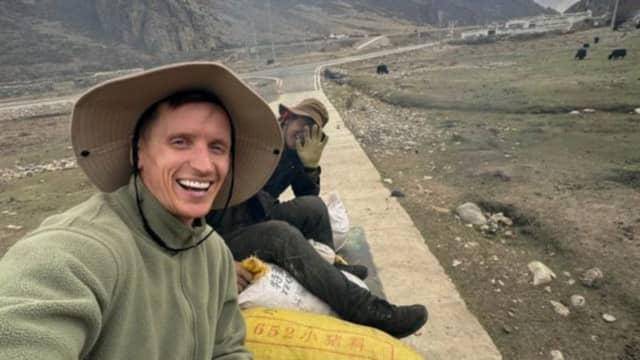
“I got stuck into some farming chores with my hosts. They use yak poo to fertilise fields, heat their homes and warm their food, so I had to collect and spread a lot of it, but I noticed that everyone else had gloves apart from me!
“My hosts were surprised that I wanted to stay, never mind do farm chores. There are only ten or 12 houses in each settlement, so all the locals work on one farm for a few days and then move on, it is a very efficient way of doing things.”
But it wasn’t the yak poo that rattled David.
“I was taken to witness a sky burial, which is how the locals deal with their dead, according to Buddhist tradition and returning the body to nature and to benefit other living beings.
“When I arrived, we were taken up the mountain to a platform and noticed there were a lot of huge vultures waiting. They were already covered in blood from a previous ritual.
“The bodies were wrapped in cloth and then a man would come and prepare them by removing the cloth, and putting them in position, he also made some openings with a hook and removed some limbs. My job was to try and keep the vultures away until the time was right.
“But it was very hard and they all rushed forward and started on one of the bodies and I was told again to join a group of others keeping them away. All this time, relatives were also watching.
“When the time was right the vultures were allowed to go in and it was very disturbing to watch, like a stampede of these massive birds but they just devoured the bodies. And all around, the relatives are there watching.
“At this point we had to leave, as when there are only bones left, and the birds were fighting over them, and if you stand too close they might mistake you for another bird competing for food and attack you.
“It was definitely a very shocking experience. Some of the older people had seen it very many times and were desensitised to it, but the younger people were very upset. It just goes to show how we have to respect different cultures, however disturbing it was to witness.”
David said he also struggled with the altitude, with many premises giving out tins of oxygen.
Then it was on to Mongolia for another farm stay.
“I wanted to buy a sheep for the family I stayed with, and they slaughtered it in front of me,” he said.
“They are so efficient in what they use, the fleece, intestines, rectum, bag, they kept the blood as well.
“They either ate it or used it for something, even the bones are kept for a type of board game, like snakes and ladders, I played a few times but I came last every time, the kids kept beating me.
There were two visits to China in 2024, with a stop-off at the smallest hotel room in the world in Hong Kong.
And despite getting food poisoning, nothing will stop David trying a local delicacy.
It is said that in Guangdong Province, people eat ‘everything that flies, everything that runs, everything that swims and anything else’.
And what better way to prove this than trying the region’s most controversial dish, mouse!
“When we arrived, the restaurant was well outside of the city, underneath a motorway bridge and empty when we arrived. It was the dirtiest place I have ever been, the guide didn’t want to go.
“We first ordered cockroach, but they gave us something else, but it was still a big bug, we had to peel off the back, the shell, and suck out the insides, like pus or liquid. It was disgusting and had a very strong medicinal taste.
“I found the mouse really difficult, it was quite large and I was told it was farmed, I had to work my way round the mouse tearing the meat off the bones, it sounded stupid but I thought it was going to bite me.
“However, it did actually taste a lot like chicken.
“The tradition for eating mice came from the time of Mao and the famine, people outside the city were forced into eating field mice and perfected the cooking process.
“Ironically when we left, the place was full and everyone in there had about five or six mice on their plates.”
David also travelled to Wuhan, said to be the epicentre of the coronavirus pandemic, but assured us that no bats were eaten.
“I was really surprised, I expected it to be old, industrial and dilapitated, but there was really good modern infrastructure, skyscrapers and fast trains.
“With 11m inhabitants, it is bigger than London, it was super modern and clean, with good food and really affordable, of all the seven cities I have visited in China, it impressed me the most.
“The wet market where the virus is said to have come from was closed, but I went to the university where they are meant to have done all the testing for SARS viruses and there was a building called ‘Animal Lab Testing Facility’ - it did seem too good to be true!”
David is now heading to Pakistan with his Dad, to watch a cricket match or two, and then back to Afghanistan.
“They said that Pakistan is on a par with Afghanistan for the people being friendly and I want him to experience that,” he said.
“I want to open peoples’ eyes to show how good these countries and their inhabitants are, it will be a great opportunity for us both. I’d love to go across the Kyber Pass between both countries too.
“On the itinerary is the flattened compound where Osama bin Laden was killed and his hide-out in the Tora Bora caves.”
As mentioned, David detests the idea that he is an influencer, but admits that he still does get recognised.
“I hate clickbait and silly videos, that sort of thing is never going to last,” he said.
“But I was out in Belfast last week and a waiter asked me if I was the guy from TikTok and a couple of girls working at the Northern Ireland game last week asked me the same question - I was a bit scundered to be honest!
“It’s nice to have people ask me questions when I am in Afghanistan, but at home in Northern Ireland, it’s embarrassing, don’t ask me why!”