

The year Antrim's over-flowing sewers left plan for 100s of new homes 'up s*@! creek'
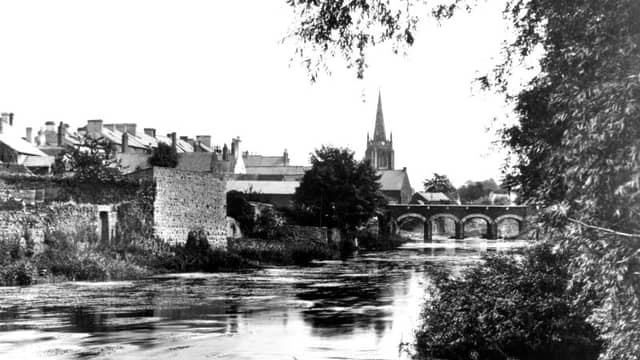

WHEN you think of the Six Mile, what images immediately spring to mind? Is it the splash of the dollaghan? The brilliant blue flash of the Kingfisher? The majestic flight of the heron? Maybe the spectacle of an otter absent-mindedly crunching on its lunch?
WHEN you think of the Six Mile, what images immediately spring to mind?
Is it the splash of the dollaghan? The brilliant blue flash of the Kingfisher? The majestic flight of the heron? Maybe the spectacle of an otter absent-mindedly crunching on its lunch?
Well, back in 1973 visitors’ impressions were coloured by an altogether different sight - and it had nothing to do with the wild brown trout.
Oh no, this was very much man made. And it was absolutely disgusting.
Nowadays people are rightly concerned about the environment, to an extent that would probably be utterly baffling to local folk half a century ago.
But even in those slightly less enlightened times, the grim reality of thousands of untreated ‘flushings’ bobbing through the heart of Antrim was raising eyebrows and turning stomachs.
The town was under siege from a rising tide of you know what - to such an extent that it was threatening to derail plans for hundreds of new homes in the new fangled housing estates that were rapidly encircling old Antrim.
Jack Allen, who was about to embark on the longest run as Mayor in Northern Ireland, was then the chairman of Antrim Rural Council.
And he was prepared to make a splash in March of that year as the Housing Executive presented a building schedule for the town which was frankly unprecedented in scale and scope.
“This is a magnificent programme and I’d like to offer my congratulations,” he said.
“It certainly shows the Executive means big things for Antrim, but - and there is a great big but here - we are falling behind on all the other services required to cope with these house.
“We don’t as yet have this ‘sewage farm’ of ours and it won’t be in operation for another 18 months. The existing plant cannot cope with the sewage from Antrim at the moment.
“Raw sewage is floating down the Sixmilewater.
“I was standing at the river on Sunday with a few medical people and they said it was a ‘disgraceful state of affairs’.
“Here we are pushing on with this magnificent programme of house building and we cannot deal with what we have.
“The existing works were designed to cater for 4,000 of a population and we are now squeezing in the effluent of from 16,000 to 17,000. And it is going to be more.”
John Gawn, the council’s engineer, said that as far as water services for the epic building plan were concerned, there was ‘no problem’. Sewage, he conceded, was a different story.
Improvements had been carried out but he conceded the effluent epidemic had been treated in a ‘makeshift’ way.
As for Mr Allen’s complaint about raw sewage, he contended that the bulk of it was not coming from Antrim. No, Muckamore was to blame!
Mr Gawn revealed that out ‘there’, the contents of the toilet were not discreetly piped away for treatment. Instead they were discharged straight into the river. Lovely.
A scheme to prevent any more muck was ‘out to tender’ but re-advertisement had been necessary and new tenders were due to be opened that very month.
But James McDowell said the assembled members should not be shocked by the revolting revelations. As far back as 1967, he said, the county surveyor had told the council that it must get a large main sewage works before mid-1968 because of the County Council’s ambitious road programme.
“Why had there been all that delay?”
Jack Allen, in an answer that showed why he went on to be a giant of local politics for decades to come, said he was ‘not really concerned about the past but about the present and the immediate future’.
“What are we going to do about it now?” he asked.
“We cannot go on building this huge number of houses and pulling in people from Belfast and wherever without the basic services to cope with them.”
Dr Bolton Minford said that without urgent action, the outlook was grave. He said there appeared to be just two options - either the house building programme had to be stopped, or works out at Milltown had to be accelerated.
Clerk Sam Magee, who was appointed Chief Executive later that year and would go on to hold the reins for 32 years, said that the Milltown project was ‘progressing satisfactorily’.
In view of that he ‘did not see there was much the council could do’. It could not, he beleived, ‘bring pressure to bear anywhere’.
“We are always hearing today about pollution and the importance of good standards of effluent,” replied Mr Allen.
“Yet the council is permitting raw sewage to enter the Sixmilewater. It is disgusting.”
Worse than that, Dr Minford reckoned it could pose a serious health hazard.
“No private individual would be allowed to act in that way,” he said.
Mr Gawn said that ‘if things had bee normal’ the Muckamore scheme would have already been underway - adding that it was unlikely to start for several weeks at best.
But that was not good enough for an increasingly agitated Jack Allen.
“We must get our professional people to state categorically that the existing facilities are not sufficient to cope with any more new houses,” he fumed.
“We should have a meeting with the Executive, the Commission and the Ministry to thrash this thing out.
“Just what is happening with the Ministry? Why all this foot dragging?”
Replied the clerk: “That is certainly not a question to which I can give an answer. Is Mr Allen suggesting that we write direct to the Ministry rather than to the Commission?”
To the very top, said the implacable UUP man.
“Take positive steps to make our presence felt,” he said.
So how many houses are we talking about here? The answer is pretty eye-watering.
In March 1973 there were 1,322 new homes under construction. Another 494 were due later that year, with 484 earmarked for 1974 and 219 the following year. Building of 71 was at tender stage and a further 1,051 were at design stage with land acquired.
A total of 346 were to be built in proposed schemes for which the land had been obtained and 70 in schemes were land issues were still outstanding.
All told, the total number of houses involved under the various headings was 2,860.
Fact fans might like to know where and when the builders were due to make their presence felt.
In January ‘73 work commenced on 32 new homes in Crumlin; in February, Parkhall (39); in May, Parkhall 3C (121); that same month, Rathenraw 1 (324); in June Town Parks South 2 (100); in November, Rathenraw 2 (306); and in December, Town Parks South 2 (200).
Rathenraw 3 (336) was scheduled to start in July 1974, with Templepatrick earmarked for 10 at around the same time.
Councillor W Dundas said that among this industry, consideration should be given to the ‘old and infirm’ who would prefer to live in a single storied home - freeing up bigger houses for families.
Charlotte Reid, from the Housing Executive, said they would have - but only seven were on the current waiting list.
But these were huge figures, by any standard - and they exposed further shortcomings in Antrim as it prepared to make the quantum leap from quiet county town to buzzing suburban centre.
The people may be coming, but where were they going to spend their hard-earned cash?
This, too, vexed Councillor Allen.
“Our town centre as it stands was able to cope with the smaller population but since the development proposals were announced not a thing has been done and as a shopping centre it has deteriorated rather than progressed in the past five years,” he said.
“The population of around 17,000 today is likely to go up dramatically in the next two years as all these new homes come forward but there are just no shopping facilities adequate for it.
“The Ministry, I understand, don’t even have the report of the inspector who conducted the public inquiry into the town centre plan yet it was supposed to be in by last Christmas.
“There is something wrong at HQ and this council is not doing its duty unless it makes itself heard clearly and loudly at ministerial level.
“We have a crisis on our hands and we are not facing up to it.”
But they got it sorted, right?
Well, the houses went up - though quite a few have been toppled since - and, in time, a shopping mall rose from the rubble of Castle Street.
And yet here we are 51 years on, with building sites on practically every available apron of land.
The sewage system is groaning once again.
Shoppers are hardly spoiled for choice.
The more things change, the more they stay the same...