

Unearthing the dark story of the Borough's 'Resurrection Men'
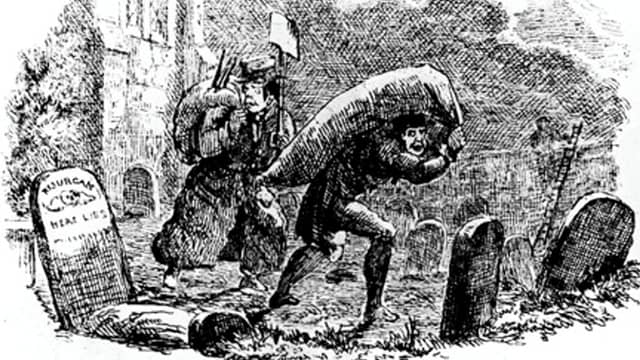

IN a corner of the graveyard at St John’s Church at Donegore stands a curious little building. They call it the ‘dead house’. The church dates back to the 17th century and many of its headstones have been blasted clean by the passage of time.
IN a corner of the graveyard at St John’s Church at Donegore stands a curious little building. They call it the ‘dead house’.
The church dates back to the 17th century and many of its headstones have been blasted clean by the passage of time.
One that remains clearly legible, however, belongs to Sir Samuel Ferguson, a scholar and poet who shuffled off this mortal coil in 1886.
One of his poems records a visit to Westminster Abbey:
‘Amid the tombs of England's dead
I heard the Holy scriptures read...
Yet hold not lightly home, or yet
The graves in Donegore forget’.
But truth be told, strenuous efforts were taken to ensure that the local dead could rest in peace. Gone, but not forgotten.
For the ‘dead house’ was not a vault to exult the passing of a person of social standing - it was a practical response to the scourge of the ‘Resurrection Men’.
They took to grave robbing to supply the growing interest in anatomy in the early 18th century.
Back then ‘subjects’ were supplied by the gallows principally - a rather productive source, given that petty offences were punishable by death in those days.
But as demand increased, a new profession was born.
Usually working in pairs, they made silent sorties to the graveyard in the dead of night, seeking newly-made graves. Then they deployed a crowbar - a bar of iron dressed to a chisel point and specially cranked to facilitate the speedy opening of a coffin.
It was a lucrative business. In December 1808 a medical institution was offering then then princely sum of £5 for ‘good, fresh corpses’ - and upwards of £10 if they died of an obscure complaint.
Bizarrely, it was a greater crime to steal a shroud than a body. According to the law it was only a misdemeanour to steal a dead body, but it was a felony punishable by transportation to steal the clothing.
That sorry state of affairs was finally laid bare at the trial of Burke and Hare in 1828. They took ‘freshness’ to a whole new level, and began murdering their subjects. Consequently the matter was made the subject of statutory legislation and became governed by the Anatomy Acts of 1832 and 1871 which placed the supervision of schools of anatomy under the control of a Government Inspector.
In the meantime, however, there were the death houses where the dearly departed rested for five or six weeks until they were no longer of practical use of anatomists before being buried. Effectively it was a waiting room for eternal rest.
One can only guess how many graves were robbed during those deeply distressing days - and how many local families were devastating, or oblivious, to their grievous loss.
But unpleasant as it undoubtedly was, there were stories of raids that did not go as planned. Gallows humour, if you like.
Take an incident at the small churchyard at Mallusk.
The Resurrection Men had been harvesting the dead, so the church had erected an iron lamp so the caretaker could see at a glance if there was anything untoward going on by night.
One night two men had succeeded in digging up a body and they carried their valuable cargo to a cart which they had parked outside. They placed the body, wrapped in some sacks, on the middle of the driving seat.
They then went back to restore the grave, but while they were away a ‘late reveller’ passed by and he called over to the curiously dressed person on the cart. Receiving no response, he went over to investigate.
The story goes that when he realised what was happening he decided to wrap himself in the sacking and take the body’s place.
In due course the two men returned and sat at either side of the ‘corpse’, and were soon on their way to Belfast to complete the sale. But when they came to a fork in the road, the pair began to argue nervously. The Antrim Road was quicker, said one, but the back road that crossed the Flush River was quieter, said the other.
As they remained halted at the junction the ‘corpse’ quietly lifted his arm and pointed towards the Antrim Road and whispered: “I prefer that way.”
With ‘howls of terror’ the robbers leapt from the cart and fled leaving their passenger with ‘a good horse and cart and a tale to tell’.
It has been suggested that one of the most active groups of ghoulish entrepreneurs targeting the dearly departed two centuries ago was based up the road near Kells.
The Connor Gang had a reputation as ‘one of the most daring and unscrupulous of the body-snatching outfits in the whole of Antrim’.
They were ‘young and reckless’ and they found working the land by night much more profitable that working it by day, so much so that they could afford to ‘get drunk every night of the week’ - an achievement that was rare among labouring folk at that time.
They made do with 10 shillings a week. Compare that to £10 a night.
They were so active that prior to the construction of the dead houses relatives were forced to stand guard over the graves of their loved ones until decomposition had set in.
Undeterred, the Connor Gang decided to try a different ruse to bankroll their drinking...
There was a certain local doctor who was in the habit of buying their grisly wares, and who had a reputation for driving a hard bargain. The gang decided to get their own back on him by selling him the freshest specimen they could - a live body.
A member of the gang was chosen to play the part. He was a ‘tall, thin fellow with a long cadaverous face’ and when he was duly installed in a wooden box and covered in a white sheet, he certainly looked the part.
They travelled to the doctor’s house and the usual haggling began over the price. When the doctor looked at the ‘corpse’ he declared in disgust that it was a poor and emaciated specimen and therefore not worth the market price.
The gang said they would take the goods elsewhere and the squabble escalated.
Unfortunately, the ‘corpse’ then entered the fray by blowing his own cover.
“Don’t sell me too cheap,” he said, halting the negotiations dead in their tracks.
The group beat a hasty retreat pursued by a ‘stream of vituperation such as they had never heard before from the lips of a medical gentleman’.