

'We all just hammered on. There was nothing else for it'
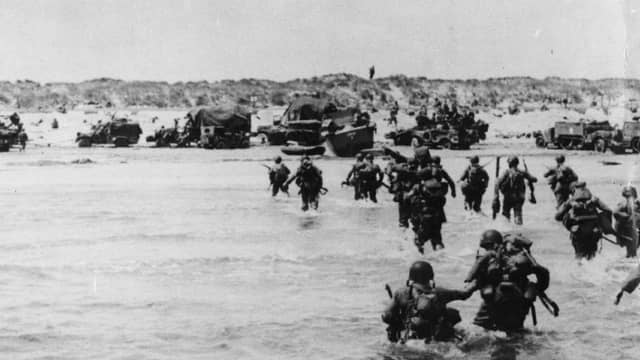

THE efforts of the paratroopers had been valiant, but their sacrifices would all be for naught if the assault troops huddled in the countless assault craft bobbing towards the French coast failed to establish a beachhead and move inland. Jack McCandless’ torpedo boat was assigned to clearing a path through the offshore German mines as the first waves of landing craft steamed towards the beaches. In later years he was modest about his critical role.
THE efforts of the paratroopers had been valiant, but their sacrifices would all be for naught if the assault troops huddled in the countless assault craft bobbing towards the French coast failed to establish a beachhead and move inland.
Jack McCandless’ torpedo boat was assigned to clearing a path through the offshore German mines as the first waves of landing craft steamed towards the beaches. In later years he was modest about his critical role.
“We had the easy job, marking the channels for the second wave of troops.
“It was the men in the first wave who had to sail through the then-unmarked mines - they virtually did the job for us.”
Nonetheless, the local man left his mark on history when he inadvertently delayed the second wave’s landings by ten minutes - a combination of the vagaries of wireless links and McCandless’ strong Antrim accent meant that advancing British ships erroneously received the message that a mine had not been marked.
“All I could see were ships zig-zagging, reversing, changing course,” he recalled. “There were about ten minutes of panic before I managed to get the correct message across!”
Dazed by a thunderous naval barrage and aerial bombardment from Allied bombers, the Germans in their concrete fortifications nonetheless put up a stout resistance. Scenes of abject horror played out alongside those of conspicuous heroism and nightmarish surrealism.
RAF fighters filled the sky as engineer Hugh Lorimer splashed ashore onto Sword Beach. Dashing from the shallows onto French soil under a hail of machine gun and mortar fire, past dead and wounded British troops, one thought flashed into his mind: “Is there anyone, anywhere in the world, living a normal life?”
Rattling ashore alongside were pragmatically constructed special engineering tanks, idiosyncratic in appearance, Darwinistic in inception, the culmination of a years-long scientific game of militaristic rock paper scissors intended to counter any defences the troops on the beaches might face.
Tanks with great thrashing metal flails designed to detonate buried mines, tanks with huge bunker-busting mortars, tanks with enormous bundles of fascine for quickly bridging anti-tank ditches - they made for a curious sight as they clanked and lurched about their work in reducing the German defences.
“One of the lads stopped to pick up a man we thought had been hit and killed,” the local man would later tell the Antrim Guardian. “As it turned out, he was only stunned and he certainly didn’t get much sympathy from his Good Samaritan. He said, ‘My God. We trained you for four years and you’ve only lasted ten minutes!’
“Of course I was scared. Everyone has a certain amount of fear. Even heroes must be frightened, but we all just hammered on. There was nothing else for it.”
So far, the Allied command had reason to be cautiously optimistic. The German response had been ferocious, but early reports from the beaches were encouraging.
The Americans at Utah faced something of an anti-climax when they met with minimal resistance, largely because tidal drift had put the assault troops ashore on a markedly less heavily defended section of coast than they were supposed to hit.
British commandos from Sword had moved inland to relieve the paratroopers at Pegasus Bridge, Gold Beach was secure despite hundreds of British casualties, and the Canadians at Juno - some units wading ashore with bicycles to facilitate a speedy advance - had put the ghost of Dieppe to rest by pushing further forwards than any other seaborne Allied force on D-Day.
The exception was Omaha, where Sub Lieutenant Agnew and the crew of the Baudoin were due to land crack US troops of the 5th Ranger Battalion.
There, on a cresting, six-mile long stretch of sloping beach overlooked by steep bluffs, the landings in the early hours of the morning proved so disastrous that US general Omar Bradley even considered evacuating the surviving assault troops - a move that would have put the entire Allied lodgement in Normandy in jeopardy.
As the landing craft of the first waves dropped their ramps, machine gunned men tumbled and piled on the bows ‘like ears of corn on a conveyor’. The beach was a perfect killing zone, and nowhere was safe from German fire.
Beneath a crimson tide whipped and lashed by bullets until it looked as though it were boiling, overburdened assault troops were dragged to the bottom of the Channel by their heavy packs. Among the X-shaped tank stoppers that lined the abattoir sands, clanging machine gun ricochets and bursting shrapnel killed or wounded scores of sheltering men, stunned silver fish washing up on the shore as severed human arms, legs and heads floated like driftwood in the bloody surf.
Even the comparative shelter of the barbed-wire lined seawall proved illusionary when German mortar shells whipped the shingle stones there into an organic buckshot shrapnel that tore indiscriminately into the dead and the living.
The slaughter was so complete that one company in the first wave, Able of the 29th Infantry Division, lost 98% of its combat strength in the first fifteen minutes. The survivors did so by ‘tide-walking’- lying prone at the high water mark, nostrils above the water, and inching ashore at the same glacial pace of the tide.
Trapped on a shrinking and increasingly congested beach between the rising tide and the Germans fortifications, those still alive resembled shipwrecked castaways rather than elite assault troops. Soaking wet, stunned, leaderless, often having discarded their weapons and equipment in the struggle ashore, simply staying alive was a battle.
The Rangers aboard John Agnew’s ship would prove instrumental in breaking the deadlock, blasting holes through the barbed wire and leading the bloodied American troops in a victorious assault on the German defences. By the day’s end, the Americans had taken Omaha - but at a cost of 5,000 casualties.
“I don’t think anyone involved in the D-Day landings could ever forget it,” remembered the local sailor, who also recounted how, as the Baudoin steamed back to England to pick up troops for the next phase of the invasion, the crew discovered a pair of fortuitous Rangers who had missed out on the Omaha landings by virtue of having slept through them.
“The weather was bad on the way across the Channel and they were very seasick. Then they fell asleep and missed their cue!”
By the end of D-Day alone, over 10,000 Allied troops had been killed or wounded breaking through Hitler’s vaunted ‘Atlantic Wall’.
The terrible human cost of securing a firm footing within ‘Fortress Europe’ was steep to say the least, but, by the end of that pivotal day, the tide of the Second World War had turned against the Axis Powers by a catastrophic margin.
Already struggling to hold back the vengeful Soviets on the Eastern Front, Hitler could scarcely afford to divert troops and resources to fight on the newly opened ‘Second Front’ in France.
As soon as the Western Allies established themselves in Normandy, the final outcome of the war was no longer in contention. Only the grim question of how many more lives would be sacrificed to end it remained.
For the 156,000 Allied troops in Normandy by dusk on June 6th, 1944, the relief at surviving the greatest amphibious landing in human history was short lived. There was still another year of pitiless fighting ahead before Nazi Germany would finally be subdued, and many who lived to tell the tale on the evening of D-Day would not see the war’s end. Indeed, another 200,000 white crosses would sprout upon the French soil before the liberation of Paris in August 1944.
“We lost all sense of time,” said Hugh Lorimer of the grim march to ultimate victory.
“One day merged into another. All we knew was we just had to keep hammering on.”