

'We're going places' - the day a pilot mistook disused wartime airfield for Aldergrove!
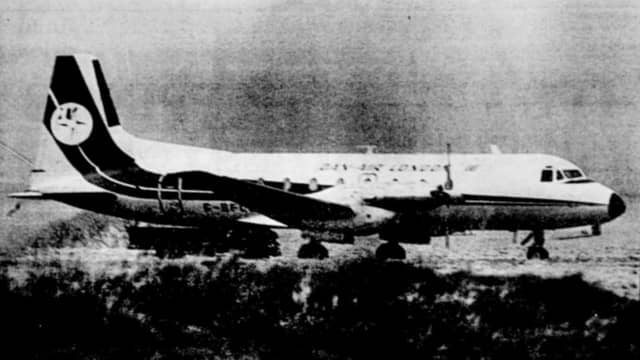

LAST week saw the 35 anniversary of what is commonly known as an ‘oops’ moment for a pilot bound for Aldergrove airport. On 2 March 1989, a Dan-Air HS 748 took off from Newcastle with 29 passengers on board.
LAST week saw the 35 anniversary of what is commonly known as an ‘oops’ moment for a pilot bound for Aldergrove airport.
On 2 March 1989, a Dan-Air HS 748 took off from Newcastle with 29 passengers on board.
When the aircraft broke cloud over Lough Neagh on short finals for Aldergrove’s runway 7, the pilot in command spotted what he thought was the runway and proceeded to land the plane at what turned out to be the privately owned World War 2 airfield at Langford Lodge, just under a mile short of the approach to the intended destination.
As the air traffic controllers in the tower scratched their heads, wondering where the plane they’d given clearance to land had disappeared to, a voice came over the tannoy.
‘We’ve landed...but we’re not where we should be.’
Passengers were unaware of the mistake until it was time to disembark - with no stairs, they had to make do with a ladder and a large box to clamber onto the tarmac.
They were then taken to a staff canteen at Langford Lodge Engineering for tea and biscuits to await a bus for Aldergrove.
It was revealed that air traffic control refused to give clearance for the plane to take off again to complete its journey to the airport.
A spokesman said Langford Lodge was unlicensed and the controllers were not permitted to give clearance from there as to do so would have ‘compounded the mistake’.
In news reports from the time, Dan-Air said that the weather - and pilot error - were to blame.
Flight DAI4I left Newcastle on Tyne with 33 people on board as usual.
Dan Air said Captain Reg Hood’s flight came under radar control from a position south of Belfast for an approach and landing at Aldergrove.
The approach took the Hawker Siddeley 748 aircraft close to the private airfield, used by RLC, which makes ejector seats, and in ‘the prevailing conditions of strong easterly winds, cloudy, with light rain showers’, the pilot mistook the airfield as Belfast Aldergrove.
A company spokesman said it was reviewing landing procedures to prevent a repeat.
The pilot and his crew were flown to London for an inquiry.
A spokesman for Dan-Air said he could not confirm whether it was Mr Hood or his co-pilot who was at the controls when the plane landed.
He said a Portuguese plane had landed at the American airforce wartime base about eight years ago but took off immediately.
“I wouldn't like to say we are blaming the weather conditions completely, there are a number of factors to be considered,” a spokesman said after an inquiry into the ‘runway boob’.
Later reports said that the pilot was suspended.
Sources close to Dan-Air said: “Although his dismissal will be subject to appeal, at this stage it is very likely the pilot will get the sack.”
The Civil Aviation Authority’ Northern Ireland manager Mr David Brown described the landing as ‘very much an unusual incident’.
It’s not the first, last or only time that a pilot has got confused.
Back in 2006, Flight 9884 from Liverpool, an Eirjet plane flown on behalf of Ryanair, landed six miles away from City of Derry Airport at Ballykelly army base with 39 bemused passengers on board.
And Langford Lodge has seen many dramas over the years.
The house itself was a three-storey Georgian pile dating from 1821 on a headland jutting out into Lough Neagh.
The Georgian mansion replaced a two-storey house of 1785, said to be similar in appearance to Castle Upton in Templepatrick built by Sir Hercules Pakenham (1781-1850).
The Pakenham family sold the estate to the Air Ministry in 1940, when the RAF airfield was opened. Langford Lodge later served as NI Base Command for US troops in the second world war - especially ironic, as General Sir Edward Pakenham was the commanding officer of 5,000 Redcoats who were defeated at the Battle of New Orleans in January 1815 - the last battle between England and America.
Civilian staff from the American Lockheed company pioneered the establishment of Langford Lodge as a vital wartime depot.
It was a key wartime repair centre for damaged American Air Force planes which were hauled to the base by road from the docks at Belfast.
A railway line was opened up to transport thousands of civilian workers.
Opened in 1942, the base was an air depot for the United States Army Air Forces, as such thousands of aircraft were processed on their way to active service in Britain, North Africa, the Mediterranean and mainland Europe.
Langford Lodge was a target in Operation Grün, a second front to Operation Sea Lion, which was the planned Nazi invasion of Britain.
German paratroopers were to capture Langford Lodge, Aldergrove and Nutts Corner while RAF Long Kesh, Lisburn was to be destroyed.
The RAF resumed control of the airfield in 1946. It ultimately closed as a military airfield in 1953.
In 1959, the estate was bought by the Martin Baker Aircraft Company - which manufactures ejector seats - and Territorial Army Sappers blew up the mansion house, deeming it to be unsafe.
There were also many famous visitors to Langford Lodge. On his way to England, Glenn Miller made a stop there. The USAAF. renamed the Langford Lodge base theatre ‘The Project Magnet Hall’, where he played on August 13 1944.
Earlier the same day he played the American Red Cross Club at the Plaza Ballroom, Chichester Street, Belfast. Miller also visited Gartree and played the then-new pipe organ, which is still used to this day.
The organ itself was a gift to the congregation from the US 8th Army Air Force. Their Chaplain Reverend Norman Nygaard preached in the church on February 7 1943.
It’s also suggested that Miller paid a visit to St Catherine’s Church of Ireland in Killead, still inside the security cordon of the old RAF Aldergrove.
The Pakenham family may have moved on from Langford Lodge but you will still find their names in the worlds of politics, the military, horticulture and literature. Northern Ireland-born fiction author Michael Pakenham, now in his mid 80s, is the son of Major Dermot Pakenham - who, as mentioned earlier, was killed at Dunkirk.
His mother decided to leave Ireland to live with her cousins in America until the war was over.
Perhaps one of the most famous Pakenhams was politician and reformer Francis Aungier Pakenham - known to his family as Frank Longford.
A long-serving Labour Party member who passed away in 2001, he was famed for championing social outcasts - most notably campaigning on behalf of Moors Murderer Myra Hindley - fighting for law reforms and helping decriminalise homosexuality.
Lord Longford visited prisons on a regular basis for nearly 70 years until his death and helped create the modern British parole system in the 1960s, following the abolition of the death penalty.
In 1956 he founded New Bridge to create links between prisoners and the community. On resigning from the Labour cabinet in 1968, he launched New Horizon, a charity for homeless youngsters.
In 1972, he was made a Knight of the Garter and was also famous for campaigning against pornography - as a committed Christian, he embodied the idea of ‘hate the sin but not the sinner’.
Frank’s children include Lady Antonia Fraser, the widow of playwright Harold Pinter, writer Lady Rachel Billington, widow of the director Kevin Billington and Lady Judith Kazantzis, a poet.
Youngest son, Kevin, was the Founding Chairman of the Longford Trust, which provides opportunities for disadvantaged young people and ran the organisation until his death in July 2020.
Eldest son, journalist, writer and historian Thomas, a leading light for many years in the British Irish Association, founded in 1973 said: “The Pakenhams were anti-show and anti-snob. They would not have been at all condescending.
Frank returned to ‘Pakenham Hall’ a gothic pile in County Westmeath in the 1960s and restored the original name of Tullynally Castle.
Eliza Pakenham, his daugher, has written ‘Soldier Sailor’, a vivid account of her extraordinary family.
She still lives part time at Tullynally - the walls adorned with ancient swords and portraits of the men who used them, as well as being stuffed with their books and letters.
And what of Dan Air?
It started making losses in the late 1980s with the decline of the charter market and difficulties caused by flying numerous older aircraft types.
Following inconclusive talks with Virgin Atlantic to save Dan-Air in return for an investment of £10 million, the airline was sold to British Airways in 1992. British Airways paid a nominal £1, in return taking on financial commitments of £50 million which included debts of £37 million.
For its part, British Airways got 12 of Dan-Air's most modern Boeing 737s, a similar number of short-haul scheduled routes from Gatwick, the Heathrow–Inverness feeder service and about one-fifth of its 2,500 workers. Dan-Air was absorbed into British Airways' Gatwick operation.
On 27 November 1992, the company's name was changed from Dan Air Services Ltd to British Airways (European Operations at Gatwick) Ltd.
This remnant of the former Dan-Air formed the nucleus of what British Airways intended to be a low-cost short-haul feeder for its Gatwick long-haul scheduled services, with the aim of helping to return British Airways' loss-making Gatwick operation to sustained profitability.
As their advert always promised, Dan-Air said ‘we’re going places’.
Sadly in March 1989, the passengers went to the wrong place!