

What do you do with drunken sailors?
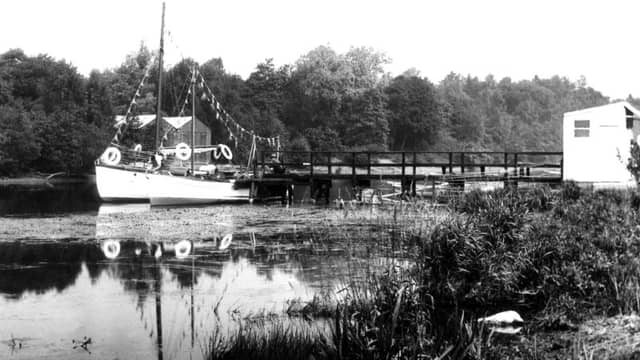

SOME times even the long arm of the law is not quite long enough to ‘feel the collar’ of more awkward wayward folk... Experienced coppers may believe they have seen it all - but then they were not scratching their heads by the banks of the Sixmile on a fine June day back in 1867.
SOME times even the long arm of the law is not quite long enough to ‘feel the collar’ of more awkward wayward folk...
Experienced coppers may believe they have seen it all - but then they were not scratching their heads by the banks of the Sixmile on a fine June day back in 1867.
What followed made headline news as people devoured details of the ‘Battle extraordinary at Antrim’.
But before we begin, apologies in advance to the good people of Arboe! The contemporary scribe was clearly not a fan.
It all began with a simple trip to market. But add a dash of the ‘devil’s buttermilk’ and things soon descended into a ding dong naval battle.
‘One day last week the quiet and industrious town of Antrim was enlivened by an amusing scene, between the police authorities and a number of rather queer-looking visitors - pollen fishers from Arboe in the County of Tyrone who had navigated a small cargo of their finny comestibles from that place, for sale in the Antrim market’, wrote our man at the scene.
‘These characteristic specimens of humanity in the Emerald Isle, having satisfactorily disposed of their entire freight, commenced to enjoy themselves in the Irish fashion, comprising, among other novel procedures, a liberal and patriotic patronage of the dealers in Irish whiskey.
‘In the course of their rollicking libations, the mirth and fun grew fast and furious, and I regret to record that they inadvertently overstepped the line of demarcation so prudently observed by Tam O Shanter and Souter Johnny - of whom it is said that, a certain memorable occasion, ‘they werena fou, but just had plenty’.
‘In due course the proceedings at Antrim terminated in an Irish row - a battle royal among the jolly frize-coated company - when afloat at a late hour of the evening; and the struggle for victory was quite as desperate as that between the heroic combatants at Navarino or the Nile’.
What’s a frize coat, you may well ask. Well, apparently the word is now obsolete, but once described ‘a woollen fabric with a long normally uncut nap’. No, I’m none the wiser either.
Anyway, back to the action.
‘Information respecting to the naval engagement soon reached the police, who forthwith marched in full force, and at ‘double quick’ - to the exciting scene.
‘But the ardour of the peace-preserving officers was suddenly checked by the discovery that the warlike craft, now occupied by the belligerents, was moored mid-channel of the stream; and as the gallant corps had not been trained to fight except on terra firma - and the construction of pontoon bridges was out of the question in the emergency - how were they to cross the water?’
There was only one thing for it.
‘There was little time for deliberation, for the battle on board was its height; and, seeing no other alternative, the entire force in rank and file of the Constabulary - like King William’s men the Boyne - plunged boldly into the rolling deep.
‘This decisive movement rather astonished the frize-coated combatants. The fight, from stern to stern, had been so hot and general, and at such close quarters, that the approach of the police was disregarded, and none perceived the necessity of united action to repel the boarders.
‘Hence the invading host, with courage uncooled by the cold element, scrambled onto the deck with little difficulty; but what historian shall relate, what pen can adequately describe the scenes of combat, the acts of heroism, the deeds of desperate daring of which they were witness in this great naval struggle for possession of the ship!
‘Of course the Constabulary demanded the immediate cessation of hostilities, and instant submission to the British flag as represented by the constituted authorities.
‘But Paddy’s blood was up and it was not until after the interchange of many a knock, laid on with right good will, that the frize coats surrendered at discretion, and ‘knocked under’ to the green-coated marines.
‘Of the killed, wounded and missing in the fight, no official return has yet been made but every opponent of the local authorities, found on foot upon the deck, was made a prisoner of war upon the spot.
‘They were marched through the town under guard of their gallant conquerors, and lodged in limbo for the night; but what happened to them afterwards, or how the prize-money, if any, was distributed, ‘deponent sayeth not’.
The passage of 155-years may have obscured the meaning of that last phrase. For the uninitiated, it is an Elizabethan Middle-English phrase meaning that the person giving testimony has nothing more to say about the matter!