

Why local people are dotty about the links to the famous Brontë family
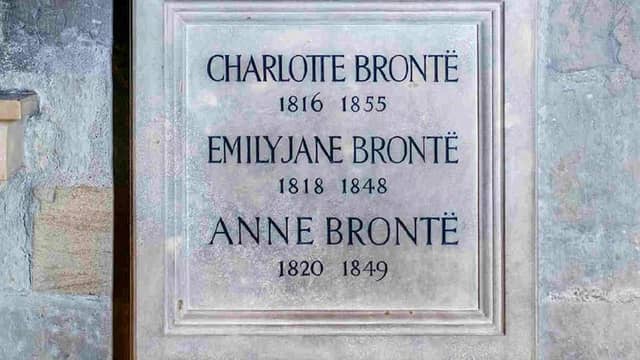

LAST week, it emerged that a memorial to Charlotte, Emily and Anne Brontë had the dots above their surname added nearly 85 years after it was first installed at Westminster Abbey - which gives the Guardian another excuse to tell of the startling local link to the famous literary family! The diaereses, the name for the two dots above the ‘e’ at the end of the Brontë name, were omitted when it originally commemorated the novelists on October 8 1939 amid the outbreak of the Second World War.
LAST week, it emerged that a memorial to Charlotte, Emily and Anne Brontë had the dots above their surname added nearly 85 years after it was first installed at Westminster Abbey - which gives the Guardian another excuse to tell of the startling local link to the famous literary family!
The diaereses, the name for the two dots above the ‘e’ at the end of the Brontë name, were omitted when it originally commemorated the novelists on October 8 1939 amid the outbreak of the Second World War.
Journalist and Brontë historian Sharon Wright, editor of the Brontë Society Gazette, raised the issue with the Dean of Westminster, The Very Reverend Dr David Hoyle and the Abbey asked its stonemason to tap the dots in and its conservator to paint them.
Ms Wright, who went to Poets’ Corner for a research trip, told the PA news agency that the dots being left off the sisters’ names ‘really troubled’ her as ‘the names of the Brontë sisters were spelled incorrectly, they didn’t have the correct punctuation on the e” so it sounded more like ‘Bront’ not ‘Brontë’.
She said she was really puzzled that in 85 years she seemed to be ‘the first person on record’ to complain about the fact the dots had been omitted.
She added: “There’s no paper record for anyone complaining about this or mentioning this, so I just wanted to put it right, really.
“And it’s lovely because it’s 85 years since it went in, in October. So it’s a sort of timely happy ending, isn’t it nice?”
Ms Wright, who is from Bradford, not far from where the sisters lived in Haworth, says: “These three Yorkshire women, deserve their place here, but they also deserve to have their name spelled correctly.”
She added that the Brontë Society, which sponsored the memorial, were ‘really happy’ with the change.
In a statement, Rebecca Yorke, director of the Brontë Society, said the group was ‘very grateful to the Dean of Westminster and his colleagues at the Abbey for their positive response to Sharon’s inquiries’.
She added: “As the Brontës and their work are loved and respected all over the world, it’s entirely appropriate that their name is spelled correctly on their memorial.”
The Dean of Westminster said: “I am grateful to have this omission pointed out and now put right.
“Memory is not a locked cupboard, but an active thing and the Brontë Society have given us a glimpse of their commitment to a lively remembering.”
Records indicate that the rectangular tablet of Huddlestone stone, measuring 600mm x 600mm and located near fellow novelists Jane Austen and Charles Dickens, did not have a formal ceremony of unveiling until July 19 1947, and the missing dots appear to have been missed.
It has long been thought that Charlotte, Emily and Anne’s father, Patrick, change his Irish surname of Prunty or Brunty as he entered St John’s College, Cambridge.
During their shorts lives, Charlotte wrote the works Jane Eyre, Shirley, and Villette, Emily put out Wuthering Heights, and Anne published The Tenant Of Wildfell Hall and Agnes Grey.
Charlotte, who married Arthur Bell Nicholls, was the last of the siblings to die, and passed away at the age of 38 in 1855.
Arthur Bell Nicholls, who was born in Killead in 1819 on Tully West Road, was by all accounts a rather bland chap who would struggle to stand out from the crowd.
He was bookish, yes, but he was also considered rather dour, strict and conventional. In short, he was a bit of a bore.
Yet he managed to court and ultimately marry Charlotte Brontë, the author of enduring classic ‘Jane Eyre’.
But before we move onto that chapter, just who was Arthur Nicholls?
He was one of nine children born to William, a Presbyterian farmer, and Margaret, a member of the Anglican Church of Ireland in Killead.
At the tender age of seven he was taken in by his uncle, the Reverend Allan Bell, who happened to be headmaster of the Royal Free School in Banagher, County Offaly.
A capable student, Arthur went to Trinity College in 1836, graduating in 1844.
And it here that things become interesting.
Nicholls was ordained deacon in Lichfield in 1845 and became assistant curate to a certain Patrick Brontë in June.
Patrick was also of Ulster stock, born to ‘a large and very poor’ family in Drumballyroney in County Down - and perhaps this is why he enlisted the young man from Killead to help him tend his flock at Haworth in the wilds of West Yorkshire.
Arthur threw himself into his new role and he visited the poor of the parish practically every afternoon - but it seems he was not widely liked.
Ever the pedant, in 1847 he carried out a campaign to prevent women from hanging their washing out to dry in the cemetery - which did little to endear him to the locals.
Indeed, when he returned to Ireland on holiday many parishioners said they hoped he would stay there and never return.
It seems that Charlotte, Patrick’s eldest daughter, was not impressed either. Initially at least.
In a letter to her sister shortly after his arrival, she gave her scathing verdict.
“Curates seem to me a self-seeking, vain, empty race. At this moment we have no less than three of them in Haworth Parish - and God knows there is not one to mend another.”
Arthur had a knack of irritating her, often unintentionally, with his ‘intolerance’. Once, he aroused her indignation so much at tea time that she attacked him ‘so vehemently that he had to leave the parsonage as quickly as possible’.
But the local man clearly saw something in Charlotte. Perhaps he was drawn to her fiery temperament. Perhaps he saw her talent and fame as an escape from the obscurity that loomed in front of him.
Either way, he persisted in his advances and soon it was rumoured that they were to become engaged - and Nicholls made no attempt to quell the whispers.
Charlotte, however, had other ideas.
“A cold, far-away sort of civility are the only terms on which I have ever been with Mr Nicholls,” she wrote.
“I could by no means think of mentioning such a rumour to him, even as a joke. It would make me the laughing stock of himself and his fellow curates for half a year to come.
“They regard me as an old maid, and I regard him, one and all, as highly uninteresting, narrow and unattractive.”
Disheartened, he resolved to return to Ulster. On the day of parting he leaned against her gate ‘sobbing as women never sob’.
But soon he was back at Haworth to continue his pursuit of Charlotte, who had just published ‘Shirley’, which included a less than flattering portrayal of Arthur as one of the characters.
She thought he would be furious, but - ever the contrarian - he loved it.
He was delighted that she had taken notice of him at all. She may have been teasing, but at least she was paying attention.
His landlady later reported that as he read the book alone in his room ‘he roared with laughter, occasionally stamping the floor and clapping his hands in glee’.
The mood soon darkened, however. In September 1848 Charlotte’s troubled brother Branwell died of chronic bronchitis.
Her sister Emily, who had penned ‘Wuthering Heights’, become seriously ill a short time later. She died of tuberculosis in December. Arthur conducted the funeral. She was just 30.
The following May, the same disease claimed her sister Anne. She was 29.
Suddenly Charlotte was very alone - and the once despised clergyman was there to offer words of comfort.
Her view of him was gradually softening, leading her to conclude that there were ‘some interesting germs of goodness’ about him.
Indeed, when he returned home for a short spell she found she missed him - much to her surprise.
In December 1852 Arthur proposed and Charlotte chronicled that moment for posterity.
“Shaking from head to foot, looking deadly pale, speaking low, vehemently, yet with difficulty - he made me for the first time feel what it costs a man to declare affection where he doubts response,” she said.
But there was one important hurdle between the couple and the altar - the increasingly eccentric Patrick Brontë.
This was a man who would feed his family on potatoes without meat because he believed it would ‘make them hardy’ - a man capable of great anger which he would relieve by breaking furniture or firing pistols out of the back door.
And he did not approve of his celebrity daughter getting wed to a ‘nobody’ from Killead.
Angered by his curate’s presumption, Mr Brontë withheld his consent and Charlotte declined the offer.
In the months that followed he made life so uncomfortable for him that Mr Nicholls resigned and left the village, taking a curacy at Kirk Smeaton, 40 miles south of Haworth.
But he continued to correspond with Charlotte and by late 1853 they were meeting secretly.
She was beginning to see a new side of Arthur.
“He is one of those who attach themselves to very few, whose sensations are close and deep, like an underground stream, running strong but in a narrow channel,” she wrote.
By Christmas Charlotte had accepted him and persuaded her father to agree.
In April 1854, she broke the news to her dear friend, Ellen Nussey.
“Dear Ellen, I am engaged. I am still very calm very inexpectant. What I taste of happiness is of the soberest order.
“I trust to love my husband. I am grateful for his tender love to me. I believe him to be an affectionate a conscientious a high principled man and if with all this, I should yield to regrets that fine talents, congenial tastes and thoughts are not added it seems to me I should be most presumptuous and thankless.
“Providence offers me this destiny. Doubtless then it is the best for me. Nor do I shrink from wishing those dear to me one not less happy.
“It is possible that our marriage may take place in the course of the Summer. Mr. Nicholls wishes it to be in July. I mean the marriage to be as quiet as possible.
“There is a strange half sad feeling in making these announcements. The whole thing is something other than imagination paints it beforehand: cares, fears come mixed inextricably with hopes. Mr. Nicholls - Arthur as I now call him.”
They were married on June 29, 1854 and Charlotte got her wish. Her father claimed he was too ill to attend, so only one other friend was present for the service at Haworth Parish Church.
She also took his name.
They honeymooned for a month in Ireland, and it was one of the happiest times of her life.
“We laugh instead of grumbling for out of doors there is much indeed to compensate for any indoor short-comings; so magnificent an ocean so bold and grand a coast I never yet saw,” she wrote.
A few months later the couple learned that they were going to have a child.
That autumn they visited a waterfall on the moors after a snow storm, but Charlotte caught a chill. She never really recovered from it.
In one of her final letters she described how her husband had looked after her.
“He is the tenderest nurse, the kindest support, the best earthly comfort ever woman had.”
Indeed he was at her bedside on March 31, 1855 when she finally breathed her last after asking Arthur: “I am not going to die, am I?”
She was just 38. Complications with her pregnancy were thought to be the cause of her death.
Arthur Nicholls stayed on to look after Mr Brontë until his death in 1861.
He had hoped to take over the living on his father-in-law's death, but was overlooked, so returned to his roots near Banagher, took up farming and never worked in the church again.
In 1864 he married his cousin Mary Anna, his uncle’s daughter.
They had no children, but as the last remaining Brontë family member, he spent decades dealing with an endless series of biographers and curio hunters.
Arthur’s great-niece Marjorie Gallop said he never forgot his all-too brief life with a literary legend.
“With generous loyalty, Mary Nicholls made every room in the house a Brontë shrine.
“The drawing room was hung with the sisters’ drawings, Mr. Brontë’s gun leaned up against the dining room wall, and Charlotte’s portrait overlooked the sofa on which Mary used to rest.
“One day it broke away from the wall, missed a table which stood below it, and fell on to Mary. Neither the portrait nor Mary was harmed.
When Arthur died in December 1906, Mary had his coffin placed beneath the portrait until it was carried from the house.
At the time of his passing only one of his siblings, Mrs Lawther who lived in Templepatrick, was still alive.
His inheritance of Brontë memorabilia was sold by his widow in auctions in 1907, 1914 and then in 1916 after her own death.
These lots contained the remaining Brontë manuscripts, personal possessions, furniture and artwork by the Brontës which Arthur brought from Haworth in 1861.
Perhaps most significantly, these released likenesses of the Brontës that had been thought lost: the portrait of the three sisters by Branwell Brontë and the quarter of a destroyed group portrait, also by Branwell, that depicts Emily.
It had been a long life, but it was definitely coloured by those fleeting nine months with Charlotte.
And when he finally passed, it was with her name on his lips.