

Tragic hidden history of the Castle Gardens
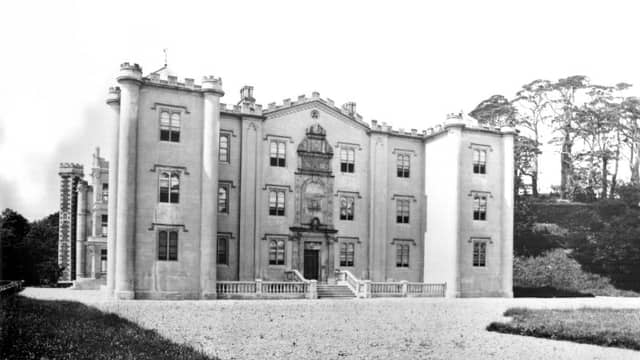

ASK anyone about the tragic history of Antrim’s Castle Gardens, chances are most would point to the fire that consumed the great house one century ago. Servant Ethel Gilligan, who was just 22, died when a fire swept through the castle after a ball in 1922. Some maintain that her spirit, the White Lady, still stalks the grounds to this day.
ASK anyone about the tragic history of Antrim’s Castle Gardens, chances are most would point to the fire that consumed the great house one century ago.
Servant Ethel Gilligan, who was just 22, died when a fire swept through the castle after a ball in 1922. Some maintain that her spirit, the White Lady, still stalks the grounds to this day.
But the picturesque gardens were no stranger to catastrophic loss, though many of these stories have been obscured by the mists of time.
This week the Antrim Guardian looks back to the 19th century to a string of bizarre accidents that claimed three lives in a single decade.
And the first, in April 1863, involved Lord Massereene himself.
John Foster Skeffington, the 10th Viscount Massereene, was a true force of nature.
He was the first Lieutenant-Colonel Commandant of the Antrim Militia Artillery when it was raised at Carrickfergus Castle in November 1854, but he had a softer side too.
He was a poet and loved strolling through the historic grounds of his ancestral home.
Indeed, that was precisely what he was doing on that bright spring morning when he spotted a yew tree had broke free of its stake. He paused to fasten it, but the stake gave way and he fell heavily backwards down an embankment.
‘His Lordship fell with great force on large rugged stones, a sharp edge of which came violently in contact with his spine, just below the neck’, said a contemporary report.
‘His Lordship was instantly so paralysed that he could not move and lay utterly powerless.
‘A little boy who had been cutting shrubbery close at hand ran to where Lord Massereene was lying and found him perfectly powerless and unable to move’.
Doctor Taggart was summoned and he had him carried on a mattress into the castle.
Three other doctors also attended ‘but it was at once totally evident that medical skill could be of no avail’.
‘No hopes of his recovery are entertained’, they concluded.
And sadly that grim prognosis was correct. He died on April 28. He was just 50-years-old.
It was a devastating blow for his son Clotworthy John Eyre Skeffington, who succeeded him.
Nevertheless, the 20-year-old proved more than capable of shouldering the burden of his new responsibilities and soon life began to return to normal at Antrim Castle.
But just three years later tragedy revisited the family.
A military man like his father, Lord Massereene spent the afternoon of November 2 1866 shooting targets from his hall door with his trusty rifle.
He continued firing until dusk when he was forced to stop because the light was dying fast.
Before packing the gun away he fired two further shots ‘in order to clean the piece’ in the direction of the lake.
He retired inside but some 10 minutes later a clearly agitated butler burst in and announced that a woman had been shot in the grounds.
Lord Massereene sent for urgent medical assistance and ordered that the woman, Mary Ann Boyd, be carried to her sister’s house nearby.
She had suffered a serious wound to her leg, which had to be amputated the next day. She died later that night.
Accidental shooting
The 11th Viscount was summoned to attend the inquest into the unfortunate woman’s death, and told them that it had been a tragic accident - and the jury accepted that.
Their verdict read: ‘That the deceased Mary Ann Boyd came to her death from the effect of a gun shot would accidentally received at Massereene Park, County of Antrim, on Friday the 2nd of November’.
Sadly, it would not be the last time that the coroner would be forced to examine the loss of life in the grounds.
On July 23 1867 Antrim Castle entertained visitors who had gathered to take part in a cricket match.
Apparently it was a thrilling affair and afterwards both teams remained for refreshments.
After enjoying a few drinks, former Royal Navy man Mr Alexander struck upon a novel idea.
“Come boys, we ought to fire the cannon,” he said.
The formidable piece of military hardware had been dragged up the motte years earlier and occasionally rang out on special occasions.
The plan agreed, gunpowder was provided by Lord Massereene’s butler and the men cheerfully set off up the twisting pathway to the summit.
Among them was local man John Kelsey. Even though he ‘showed signs of drink’, he was nominated to put the explosive cargo into the barrel.
Mr Alexander later recalled that while Mr Kelsey was ‘somewhat muddled with drink’, he felt he was ‘not incapable of charging the cannon’.
“I should not have stood near the gun - close to her - had I not considered she was safe,” he said.
And he was close, for it was he who put his finger over the vent which was used to ignite the powder when it was fired.
The cannon roared and the crowd cheered, and the fateful decision to do it again was made.
Again Mr Kelsey applied the charge, but this time a mistake was made.
A damp sponge was traditionally used to make sure that no sparks remained when returning to a recently fired cannon, but that afternoon none was at hand.
Undeterred, the local man pushed a bag containing around a pound of gunpowder into the muzzle, but before it could be ‘run home’ it exploded.
Cannon exploded
Mr Kelsey was blown some distance away and when the smoke cleared it was clear that he had suffered devastating injuries.
“A voice shouted ‘he is killed’,” recalled Mr Alexander.
“I shouted immediately for a doctor. I saw his hands, as I thought, blown away.
“The ram rod was picked up some 60-yards off.”
But Mr Kelsey was still alive.
Dr Andrew Spearing was the first to offer much-needed medical assistance.
“I saw him being brought down the mound on a door. Both arms were hanging by the skin,” he said.
He was carried into the servants’ dining room, where Dr Spearing was joined by Dr Kane and Dr Taggart - the man who treated Lord Massereene after his fatal fall 10-years previously.
All agreed that they had no option but to operate immediately.
And all appeared to go well. Both forearms were skillfully amputated, with no haemorrhaging.
“The patient was left with every hope of recovery,” said Dr Spearing.
“He bore up well under the operation. Chloroform was not administered; the state of shock he was in was equivalent to chloroform.
“Next morning, on being visited, there was no ground to anticipate an unfavorable change.
“He went on well until the third morning after. Delirium then set in, and continued with varying intensity till about seven o’clock on the evening of Thursday, the 1st of August, when his intellect again became perfectly clear.”
But that clarity proved to be a double edged sword.
“He awoke out of a short sleep, quite sensible, and for the first time apparently realised his position.
“He began to sink from that till half past 11 when he died.”
An Inquest was held in August 1867 at Antrim Courthouse when the Coroner concluded that it was a tragic accident.
“I have seen accidents of the same kind with the best hands,” he said.
“Guns have exploded when they were sponged and treated in every way that science could suggest.
“It was only last week that a gun of the Royal Artillery exploded. Two men were thrown 50 feet from the place with their arms blown off and their lives lost.
“Proof has been given that every care had been taken that could be taken and there could be no mismanagement.
“Lord Massereene doesn’t flinch from being here. No-one regrets anything that has happened more than he does.”
Significantly, the court heard that the dying man bore no ill either.
“He never said a word casting blame on anyone.”
The cause of death was recorded as delirium, aggravated by his injuries.
But while they found that no-one was directly to blame, the jury said that urgent steps should be taken to ensure it never happened again.
It was their ‘strong desire’ that the firing of cannon should be discontinued. Wisely, Lord Massereene agreed.