

300 years in the heart of Antrim
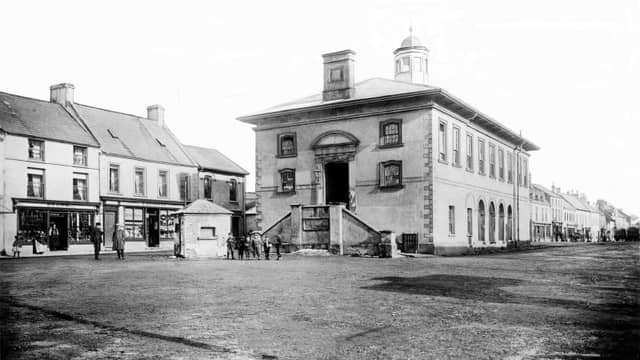

TODAY it may be a place to catch up on the latest gossip over a steaming cappuccino, but as recently as 1994 Antrim’s ‘old’ courthouse was still the scene of some arresting developments. Back then the weekly Magistrate’s Court still met in its drafty main hall each Wednesday morning.
TODAY it may be a place to catch up on the latest gossip over a steaming cappuccino, but as recently as 1994 Antrim’s ‘old’ courthouse was still the scene of some arresting developments.
Back then the weekly Magistrate’s Court still met in its drafty main hall each Wednesday morning.
It was certainly an impressive backdrop, but anyone old enough to recall it will testify that the hard wooden benches were a tough sentence for anyone unlucky enough to endure one of the lengthy sittings.
I remember it well. The defendants were shuffled in to stand right behind the press bench and many a ‘chat’ through gritted teeth was had as they implored the reporters to lower their pens for fear that their mums would read about what they had been up to!
At that time, the striking landmark at Market Square had the distinction of being the oldest working courthouse in Ireland - and one of the few from that era still standing.
Incredibly, work began in 1726 following an application to the County Grand Jury by the Hon John Skeffington, and all for the princely sum of £150.
And they threw it up pretty quickly too - possibly too hastily for one master craftsman charged with the task of marking the date for posterity.
Much to the amusement of celebrity cyclist Timmy Mallet, who visited the town last month, he carved ‘Bult 1726’ on the exterior facing the old town walls. Then, realising his mistake, he wrote the letter ‘i’ above with a helpful arrow denoting where it should have gone. Well, he could hardly have rubbed it out and stated again, could he?
It came too late for notorious highwayman Eneas O’Haughan who was caught, sentenced and hanged two years previously. Famously, he claimed to have buried a boot brimming with golf sovereigns on the western slope of McIlwan’s Hill at Ballyutoag off the Sevenmile Straight. But that’s another story...
Though it has been changed and modified down the years, its place in the town’s rich history is assured. Major murder trials have played out there over the last three centuries - and then there was the Battle of Antrim in 1798.
After a pike plunged into his side, Viscount John O’Neill looked into the eyes of his killer - and he knew him.
The date was June 7 and the Battle of Antrim was raging - with the forces of the crown facing the full-blooded fury of the United Irishmen.
Viscount O’Neill had been in Dublin a few days earlier and he knew full well that the whiff of rebellion was in the air.
In his capacity as governor of the county he summoned by public notice the county magistrates to meet in Antrim courthouse that day to discuss just that - inadvertently becoming the architect of his own downfall.
For this was too good an opportunity for hostage-taking for Henry Joy McCracken, the rebel adjutant general of Antrim, to miss and he issued urgent battle orders to march on the town.
O’Neill, meanwhile, was travelling north. He spent the night of 6 June in Hillsborough. He galloped through Lisburn the next morning without stopping and so failed to receive the warning left for him by General Nugent.
The 58-year-old arrived in Antrim a little after noon - and slap bang into the thick of the fighting.
When the Viscount arrived he was briefed on the scale of the uprising and ‘he wept, showing much emotion’. Tellingly, he also told the military to be ‘merciful’.
During the thick of the affray Lord O’Neill proposed to the military commander that he would go through the lines of insurgents and ‘parley’ with their leaders ‘in the interest of peace and the prevention of further bloodshed’. The request was denied.
His Lordship was seated on his horse at the north corner of the court house and was about to cross to Dr Bryson’s house opposite when a man in a grey coat rushed forward.
He stabbed the horse and then thrust his pike into the nobleman’s side. Mortally wounded, he fell to the ground.
He was carried to Antrim Castle, but the situation was grave. He died on June 18 to the ‘great grief’ of his family and many friends - including many United Irishmen who held him in high regard.
In a contemporary account given to General Nugent by Major Seddon, the killer was known to his Lordship - and he had an axe to grind.
“The villain who stabbed him was one named Jonathan Coleman, a former butler at Shane’s who was dismissed in November of last year,” he said.
“About the month of March past he made an attempt on my Lord’s life and then absconded. I have spiked his head on the market house.”
So this was not an act of war - it was cold blooded revenge. And it did not end up well for either man.
Today, the building is considered one of the richest classical Florentine style buildings in the province, but it was not always held in such high regard. An Ordinance Survey back in 1830 haughtily described it as ‘plain but neat looking, stone finished building’.
‘Wretched’
In 1845, the Parliamentary Gazetteer was even less impressed, branding it a ‘wretched little cluster of filthy barbarous cells’. Charming.
Now, however, it is considered socially important and of national significance.
Awarding it a Grade A listing in 1997, the Historic Buildings Branch concluded that ‘this is a handsome building, of considerable poise, which stands as not only an important local landmark and centrepiece of the town’s main square, but is also the oldest courthouse in Northern Ireland, and one of the earliest public buildings of any type in Northern Ireland.
‘As such it is of outstanding architectural and historic interest’.
The timing of this reappraisal was key. Remember, by then it had been closed for three years.
In October 1994 Lord Mackay of Clashfern, the most senior legal figure in the UK no less, had paid a rare public visit to open the gleaming new £6.4 million courthouse at Castle Way.
Its predecessor, however, lay boarded up - abandoned and looking increasingly unloved.
But not for long. By 2001 the council had purchased the building. They got a bargain basement price too, the Crown Solicitor’s Office aware of the heavy investment now required to throw open its doors once again.
Progress would be slow. By 2006, after the renovation of the old walls and Barbican Gate were complete, they were still seeking funding to help them with the seven figure restoration.
It was eventually opened to huge fanfare in May 2010, boasting a multi-purpose auditorium, a thriving Tourist Information Centre and a popular cafe.
Yes, three hundred years on, the old girl was back in public service once again!