

Former Holywell staff member calls for preservation of site's history
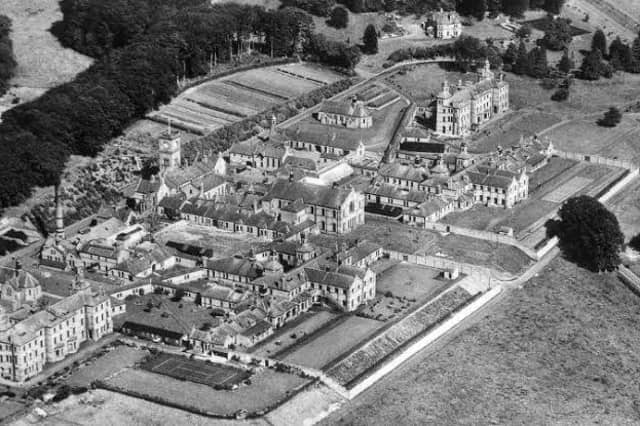

A FORMER Mayor has called for the history, grounds and building of the Holywell Hospital site to be protected.
As new archaeological findings come to light in the grounds of Holywell Hospital, a former staff member, who grew up next to the Victorian asylum, said that something needs to be done to preserve both the grounds and buildings - and the overall history of the site.
The replacement of Holywell, a Northern Trust facility, has been delayed, with the Department of Health saying there are not enough funds to progress the next stage of the replacement £143m Birch Hill centre in the grounds of Antrim Area Hospital. Holywell dates from 1900, when it was built as an asylum to designs by John Lanyon, son of Sir Charles Lanyon. It was John’s last work before his death, coming just a year after his father's. It was subsequently extended in the early 1900s, with the new wings consistent with the early design. The complex has always operated as a mental health facility.
The building has traditional period detailing of projecting brick courses, corbels, and plinths, towers and turrets. But over the years, as the treatment of people with mental health issues has changed, the sprawling complex has become increasingly unfit for purpose. Whilst no doubt impressive to look at, the listed status of many of the buildings, including the famous clock tower, adorned with gargoyles, means there is very little room to move in terms of physical improvements.
Oran Keenan, a former SDLP Mayor and retired healthcare worker, said he was 'privileged' to have been one of the families who had residency within the grounds, at Culnafeigh Green. Other families included the Barrs, who lived at the gate lodge on Springfarm Road. The Shields family home was next to Springfarm House and the farm, while the Houston family lived at Orchard Farm, which was in between Holywell and Bush House
He said: "Holywell had 270 acres, the main farm being Springfarm, which ceased to function in the early 70s . It was a dairy farm, and as children we had the run of the grounds. We saw the milking, the large hay rooks being brought into the shed .
"The farm manager was a Mr Taylor, who lived in the red brick house on the Steeple Road, where the nursery is located, beside the nursing home. Whilst there were paid workers for the farm, there were quite a few of the long stay patients gainfully employed, as a form of therapy. Similar squads of residents looked after the grounds. The ground opposite the clock tower was like a market garden for fresh flowers and small vegetables. Behind the incinerator, a few chickens were kept. The residents who worked on the squads did not require sleep medication - I believe it was deemed abuse in the early 70s .
"The railway crossing on the Springfarm Road was manned by a Mrs Carson, who also had a wee shop. There was a railway line that spurred off, to bring the supply of coal to be used in the boiler system, prior to the introduction of oil .
"As a child of the mid 50s, the line was gone, but the stones and the imprint of the railway was still evident, the line went up alongside the old sewage treatment plant. It also bypassed the remnants of the American base, where the self-build housing project is.
"The American military were also based in Springfarm House. The late Noel O'Neill was from a farm on the Springfarm Road and he remembered 'The Yanks' coming to get milk and eggs .
"As children we played in the plantation beside the main farm and in the plantation there were two dry trenches. Noel informed me that they were used for training for trench warfare, I have heard that military artefacts were found in this area. It is understood that 'the Yanks' built the Tobernaveen units .
"We must also remember that all the big psychiatric hospitals and institutions were built away from local communities, including Purdysburn, Gransha and Downshire - out of site out of mind. Indeed Holywell was also known as the
Antrim District Lunatic Asylum or ADLA. Bush House was bought from a Mr Barton, who was well travelled and brought back many specimens of trees for his garden. Bush was a female resident only building.
"Holywell had two places of worship for the main denominations of that time. Holywell House was the home of the medical superintendent and in my days had an outdoor swimming pool and a tennis court. The last matron to live in the wee cottage over from it was Miss Osborne, Holywell had its own dump, morgue and incinerator for clinical waste. One has to remember that psychiatric nursing only became a taught qualification in the mid century.
"The staff were known as keepers. Many of the residents may not have had a mental illness and many may have been misdiagnosed.
"Looking at the range of mental health disorders today, many could have been at home - but remember, out of site out mind. The stigma was very evident, ignorance of mental illness was not uncommon among the population but also among some of those charged with caring for the poor residents.
"While early day medication was welcomed, the full extent of its impact was a learning curve. Early day treatment was in a word 'cruel' - like ECT, insulin therapy and lobotomy. Treatments were often of an experimental type, sometimes making the patient worse. A lot of early days intervention were used to improve the way medication was used. Medication was not always the answer but the absence of new age therapy meant that there was little else.
"In those days, staff and patients did as they were told, today people, quite rightly, are better informed and will question any treatments. Mental health for years was the 'Cinderella' of the health service, it still has a long way to go, this can be seen by the long waiting list and the lack of treatment available for the ‘new’ illnesses that fall under the psychiatric disorders umbrella.
"Especially when one sees the long term impact on someone who can't access appropriate care and despite it being well documented, we are very slow in developing or progressing changes.
"The future of the Holywell estate may need to be taken out of the hands of the NHS. As we have seen, all too often these buildings fall into a state of decay and beyond repair and are frequently helped on there way by recreational vandalism. The three hospitals in Antrim served the town and surrounding area well, giving gainful employment and services to the community.
"On an other note, Holywell had a very good social network within the hospital, not only for residents but for staff. There was an entertainment officer Miss Huxley and the large recreational hall was used for in-house hospital dances and also for the local community and public dances.
"The annual garden fair was a big event for the community and as a fund raising event for the patients comfort funds. I remember as a new community psychiatric nurse, going to visit some one and while waiting for them to open the door, I overheard two neighbours saying that ‘so and so’ was in Tobernaveen - "Thank goodness they didn't go to Holywell " - stigma again .
"Whilst doing the CPN course at Purdysburn in 1983, one of our tutors remarked that one in seven people had a mental health issue, today it's one in four,
"Mental illness like cancer, ignores all social classes."